Winport

Spaceman Crash Game: Free Demo and Real Money Play Guide

Last updated: May 2026. Reviewed by the editorial team at winport-austria.com. 18+ only.

«When evaluating modern crash titles like Spaceman, player choice should never be shaped by headline numbers or flashy multipliers alone. A useful review places terms, legal boundaries and mathematical risks before any promotional claim.» Claire Bennett, Senior Casino Content Editor (editorial persona)

Provider

Pragmatic Play

RTP

96.50%

Volatility

Medium

Min bet

$0.20 AUD

Max bet

$100 AUD

Max win

$500,000 AUD

Spaceman Crash Game Free Demo and
Table of ContentCloseOpen
Quick Verdict

Quick Verdict

  • What it is:Spaceman is a real-time multiplayer crash game released by Pragmatic Play in March 2022. No reels, no paylines, no free spins. A multiplier climbs from 1.00× until an RNG-determined crash, and your cash out timing decides the outcome.
  • The numbers:default RTP 96.50% (house edge 3.50%), maximum multiplier 5,000×, bet range roughly $0.20 to $100 AUD, theoretical max win $500,000 AUD per round.
  • The catch:operators may deploy lower RTP configurations (94.00% to 95.50%). Open the in-game info panel and confirm the configured return before wagering real money. It takes ten seconds.
  • Standout mechanic:the 50% Auto Cashout, which lets you bank half your stake at a low multiplier while the remaining half keeps flying. Aviator and JetX need two separate bets to copy that.
  • Legal position in Australia:interactive online casino games, crash titles included, cannot lawfully be offered to Australian residents by locally licensed operators under the Interactive Gambling Act 2001. ACMA actively requests the blocking of offshore casino sites.
  • Bottom line:mechanically transparent, and genuinely skill-adjacent in terms of discipline, yet mathematically negative in expectation. No cash out pattern, progression or "signal reading" shifts the 3.50% house edge.
  • Skip it if:you want bonus rounds, free spins and scatter-driven features; you play on unstable mobile data; or you feel drawn to progressive staking systems such as Martingale.
Evaluating interactive casino games means reading

Evaluating interactive casino games means reading the fine print, understanding the mathematical structure underneath, and clarifying legal conditions before a single wager is placed. Spaceman has become one of the most prominent arcade-style multiplayer titles in digital entertainment, and it appears in the catalogues of most online casinos with Pragmatic Play content. The design moves away from traditional reel mechanics: exit timing dictates outcomes, in real time, round after round. For readers comparing this option across Australian English informational channels, three things matter most: how the crash curve behaves, what terms apply to real money play, and which responsible gambling controls are available.

Our editorial approach (updated). Our reviewers assess crash games by launching the demo build, logging consecutive round outcomes, testing every automated exit setting, and reading the operator-side rules panel to identify the configured RTP. While compiling comparison frameworks for iGaming titles at winport-austria.com, we noticed a repeating pattern in reader questions. Players arriving from standard pokies often expect a minimum 1.00× return, expect a bonus round, or assume the multiplier history predicts the next crash. None of those assumptions hold. So this review puts auto cashout parameters, operator RTP settings and legal context ahead of any promotional framing. Where a figure cannot be independently verified, we say so plainly rather than dressing it up as fact.

What is Spaceman by Pragmatic Play?

Spaceman is a real-time multiplayer crash game developed by Pragmatic Play in 2022 that dispenses entirely with reels, paylines and symbol combinations. The game centres on a cartoon astronaut launching into space while a multiplier climbs continuously from 1.00× upward, ending unpredictably when the crash lands. Unlike a standard online slot or a fixed paytable casino game, Spaceman puts the decision in your hands: you must cash out before the round stops.

Core differences between Spaceman and reel-based pokies

Pragmatic Play built this title as its flagship entry into the crash category, listing it under "Crash" in its own product catalogue rather than among video slots. Sitting on an arcade wager framework, the game is driven by a cryptographic random number generator (RNG), which is software that produces unpredictable, independently certified outcomes and sets the crash threshold for each round. The space-flight aesthetic and smooth animation form an engaging wrapper, yet the mechanics underneath stay purely mathematical: a fixed house edge and a verifiable probability curve.

How Spaceman differs from classic slots

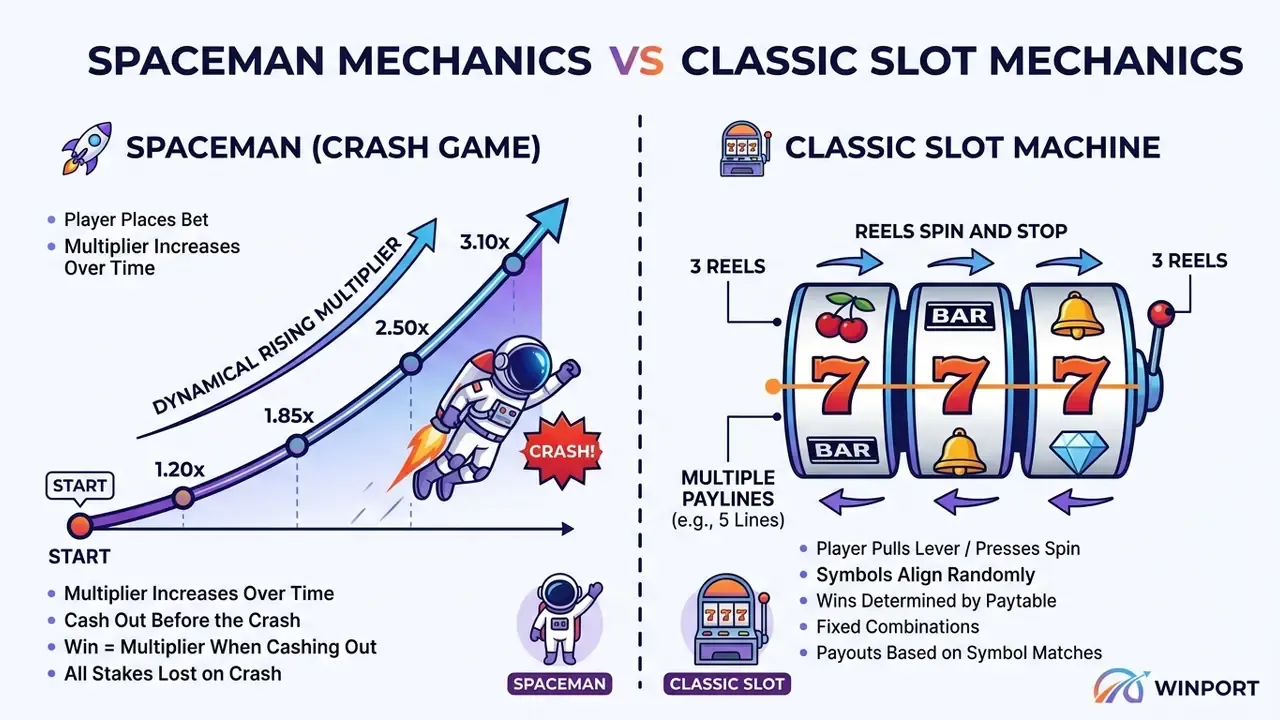
Spaceman removes spinning reels, paylines, bonus rounds and free spins features altogether. In a traditional online slot, outcomes resolve the instant you press spin, and payouts follow a static paytable automatically. The Spaceman slot works differently. It runs on a single continuous multiplier curve where your timing during the live round decides whether a payout happens at all.

The operational differences come down to how volatility and payouts are structured:

Winport heading-banner
  • No paylines or symbol sets:payouts do not depend on matching symbols across active lines or landing scatters for bonus rounds.
  • Dynamic multiplier ascent:every round starts at 1.00× and climbs until the crash point, so players choose their own exit multiplier.
  • Active cash out control:you decide exactly when to press cash out, trading lower multipliers for higher win frequency, or chasing bigger multipliers at greater risk to the stake.
  • Single-decision loop:each round involves one core choice, namely the stake size and the moment you collect before the crash.
  • No guaranteed 1.00× return:a round can end at the very start of the flight. Unlike a low-volatility pokie, where frequent small hits cushion a session, every Spaceman round is binary until you cash out.
Theme, graphics and the multiplayer format

Theme, graphics and the multiplayer format

The theme revolves around a cheerful, cartoonish astronaut drifting across a pastel cosmic backdrop with stellar particle effects and clear technical indicators. As he ascends, the live multiplier sits prominently on the central screen next to flight telemetry. The audiovisual layer intensifies at higher multipliers: the electro soundtrack builds, the sky shifts, the animation accelerates. Tension rises. The maths does not change one bit.

Beyond the single-player control panel, Spaceman is built as a shared arcade experience. Everyone in a given round sees the identical flight path, multiplier trajectory and crash point at the same moment. The interface includes several live social features:

  1. Live bet feeds: a sidebar showing active bets placed by other players in the current round.
  2. Real-time cashout indicators: markers showing when other participants exit and at which multiplier.
  3. Community chat: an integrated chat box for talking during gameplay.
  4. Round history charts: a public ledger of crash points from recent rounds, usually the last 50 to 500.
Interactive control panel and dashboard features

Interactive control panel and dashboard features

Beyond the stake field and cash out button, the Spaceman interface carries controls that materially affect how fast a session moves, and how fast a bankroll disappears:
  • 2× (double bet) button:doubles the previous round's wager with a single tap during the 10-second betting phase. Convenient, sure, though it is also the quickest path into an unplanned progression, so treat it carefully.
  • Multiplier ledger (top bar):displays historical crash points for recent rounds, colour-coding low (below 1.50×), medium (1.50× to 5.00×) and high (above 5.00×) flights. Important: the ledger is a record, not a forecast. Each round is independent, so a run of low crashes never makes a high multiplier "due".
  • Live bets and chat sidebar:a real-time feed of global stakes plus a chat room. Social pressure inside chat is a known behavioural risk factor; the feed can be collapsed, and often should be.
  • Statistics panel:aggregated data such as top multipliers of the day and the biggest wins in recent rounds.
  • Auto Cashout and 50% Auto Cashout toggles:pre-round automation settings, covered in detail below.
  • Previous results tab:your personal betting history for the session, with stake, exit multiplier and net result per round. Honestly, this is the most useful control on the panel for self-assessment.

How Spaceman Works: Bets, Multipliers and Cash Out

A Spaceman round follows a simple sequence. Players place bets in a short pre-flight window, watch the multiplier rise from 1.00×, then try to cash out before the crash. The core tension is risk against reward: waiting for a higher multiplier increases the chance the astronaut crashes first, and any unhedged stake is gone.

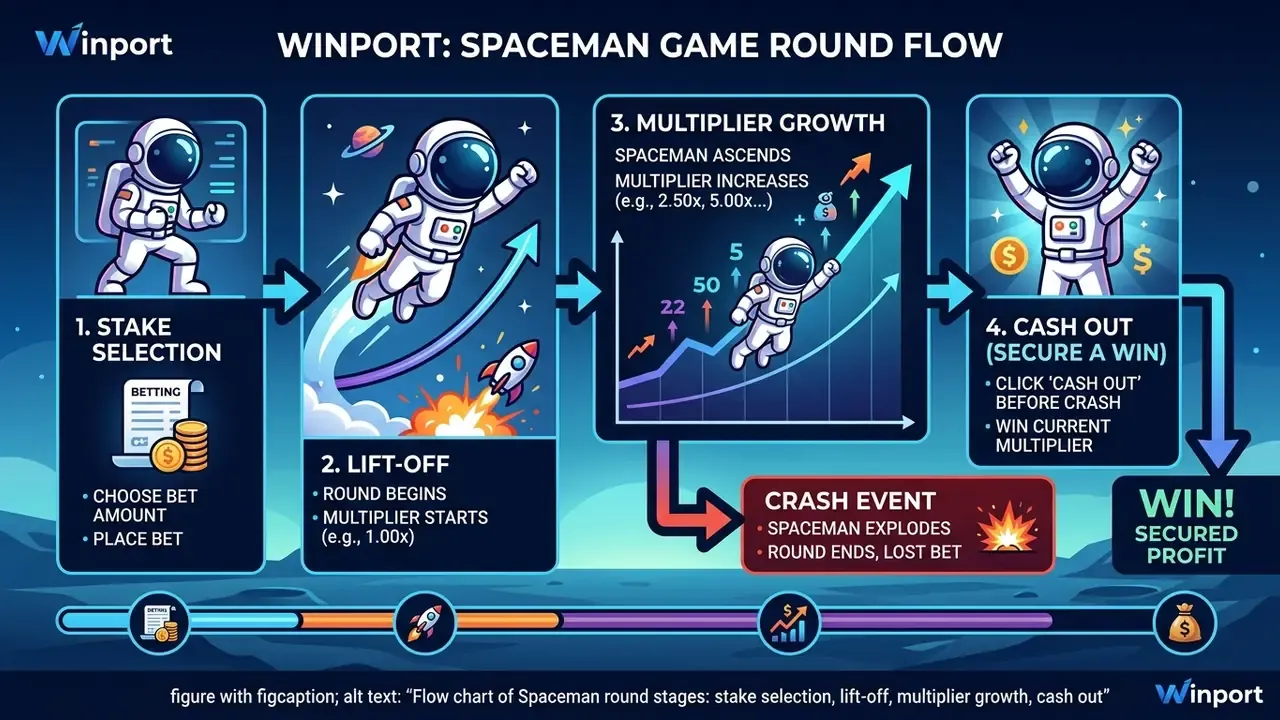
Stages of a Spaceman round, from stake selection to locking in a win
The round progresses through five explicit

The round progresses through five explicit stages:

  1. Betting phase: players choose a stake within the permitted minimum and maximum limits during a 10-second countdown.
  2. Lift-off: the betting window closes, the astronaut launches, and the multiplier starts at 1.00×.
  3. Ascent and multiplier growth: the multiplier climbs continuously in real time along the RNG curve.
  4. Cash out action: the player clicks cash out manually, or lets an automated setting lock in the current multiplier.
  5. The crash: the flight stops without warning, ending the round; uncollected stakes are forfeited immediately.

When a bet wins and when it loses

A bet wins if the cash out command is executed, manually or automatically, before the RNG-determined crash. Once the exit is confirmed, the system multiplies your stake by the multiplier visible at that moment. A $10 stake cashed out at 2.50× returns $25 in total, a net profit of $15.

Crash formats now sit inside a much broader online gambling environment, which is worth keeping in view before treating rounds as harmless filler between tasks.

«Online gambling participation reached 33.4% of Australian adults in 2024.» Suomi, Hahn & Biddle, Gambling in Australia 2024, ANUpoll, Australian National University (2024). https://www.anu.edu.au

A bet loses entirely if the crash lands before the server registers your exit. Because crash points come from random number algorithms, a round can end instantly at 1.00×, well before anyone reacts manually. When that happens, the whole wager for the round is lost. The result depends strictly on whether exit confirmation arrives before the crash event: server-side timestamps decide it, not what the animation appeared to show on your screen.

Auto Cashout and 50 Cashout configuring

Auto Cashout and 50% Cashout: configuring your exit

To support systematic execution and reduce the effect of latency, Spaceman includes two risk management settings: Auto Cashout and 50% Auto Cashout. Both let you pre-configure the exit before the round begins, which takes human reaction time out of the equation.

  • Auto Cashout (full exit): you set a target multiplier, from 1.01× up to just under 5,000×. When the flight touches that target, the software collects the full payout for the wager.
  • 50% Cashout (partial exit): this feature splits the position into two equal halves. When the selected 50% target is reached, the system cashes out half the original stake and banks that portion. The remaining half stays in the round, climbing until a second exit triggers or the astronaut crashes.

Using 50% cashout lets you recover your initial exposure early in the flight while keeping part of the wager working toward a bigger multiplier. It balances session risk. It does not touch the baseline house edge. Both presets can be stacked in one round, for instance half the stake exiting at 2.00× while the balance targets 5.00×.

Step-by-step how to play Spaceman online

Step-by-step: how to play Spaceman online

  1. Select a verified platform: log into your chosen online casino account through a web browser.
  2. Locate the game: open the "Crash Games", "Arcade" or "Pragmatic Play" section of the lobby and launch Spaceman.
  3. Open the info panel first: check the rules screen for the configured RTP, the minimum and maximum bet, and the max win cap that operator applies.
  4. Adjust the stake: use the plus and minus buttons or preset chips to set your total bet for the coming round.
  5. Configure automated exits (optional): switch on Auto Cashout or 50% Auto Cashout if you want pre-set exit multipliers.
  6. Confirm the bet: press "Confirm Bet" before the 10-second pre-flight countdown ends.
  7. Monitor the flight: watch the ascent and the live multiplier growth on screen.
  8. Execute cash out: click the manual "Cash Out" button, or let your automated targets trigger, before the crash lands.
  9. Review your session log: after 20 to 30 rounds, open "Previous results" and check your actual net position instead of trusting memory.

Spaceman Slot: RTP, Volatility, Bet Limits and Max Win

Disclaimer: this information is general in nature and does not replace advice from a qualified professional. RTP configurations and betting limits can differ between operators and jurisdictions.

Spaceman carries a standard theoretical Return to Player (RTP) of 96.50%, which corresponds to an average long-term house edge of 3.50%. Volatility is medium to high and, unusually, dynamic: it follows the exit thresholds you choose rather than a fixed paytable.

Technical parameterDefault specificationEditorial and operational notes
DeveloperPragmatic PlayCertified iGaming software provider with independent RNG testing (GLI certified).
Release dateMarch 2022Pragmatic Play's flagship entry into the crash category.
Game formatCrash game / multiplayer arcadeNo spinning reels or paylines; real-time rising multiplier mechanics.
Default RTP96.50%Theoretical return over extended sample sizes; house edge is 3.50%.
Alternative RTP configurations94.00% to 95.50%Operators can select lower theoretical RTP builds; always check the local game rules.
Volatility profileDynamic (medium to high)Driven by cash out timing: early exits reduce variance, late exits increase it.
Minimum bet$0.20 to $1.00 AUD (or currency equivalent)Varies with platform rules and local currency setup.
Maximum bet$100 AUD (or currency equivalent)Upper limit per round; subject to operator risk management policies.
Maximum multiplier cap5,000×Hard ceiling on the achievable round multiplier.
Maximum win limit$500,000 AUDMax bet multiplied by 5,000×; subject to casino withdrawal limits.
Bonus rounds / free spinsNoneNo scatters, wilds, bonus buy or feature triggers exist in this title.
Execution featuresAuto Cashout and 50% partial cashoutBuilt-in tools for setting systematic entry and exit rules.
Device compatibilityDesktop, mobile (iOS/Android), tabletWebGL/HTML5 browser-native build; needs a stable internet connection.

Fact check and specification verification: the parameters above are the default software specifications published by Pragmatic Play. Online casino operators, however, can adjust minimum and maximum bet limits and select lower RTP configurations (95.50% or 94.00%, for example) depending on licensing and commercial terms. Some competing reviews list Spaceman at a flat "95% RTP" with no explanation; that figure reflects one possible operator configuration, not the default build. Verify the paytable and rules in the information panel of your chosen platform before wagering real money.

What RTP and volatility mean in Spaceman

RTP is the theoretical share of total wagered money a game returns to players across millions of sample rounds. A default 96.50% means that for every $100 wagered by the whole player base over a statistically enormous timeframe, the theoretical average payout is $96.50, with $3.50 retained as house edge.

Updated: rather than leaning on the percentage alone, it helps to reframe the same figure as a cost of play. Randomised experimental work commissioned in Australia found consumers grasp the "house edge" format far more accurately than a standard RTP notice.

«The house edge format was understood correctly by 79.9% of participants, compared with 52.9% for the standard RTP message.» National Gambling Prevalence Study Pilot, Australian Gambling Research Centre / Australian Institute of Family Studies (2024). https://www.aifs.gov.au

Applied here, the plain-language version reads

Applied here, the plain-language version reads: this game is designed to retain about $3.50 for every $100 wagered. That expectation does not shift with stake size, cash out target or session length.

In crash games, volatility describes the variance and distribution of winning versus losing outcomes. Traditional pokies have static volatility. Spaceman has dynamic volatility:

  • Low volatility approach: cashing out consistently at low multipliers (say 1.10× to 1.30×) produces frequent small wins and gentler balance swings.
  • High volatility approach: holding for large multipliers (10× to 50× and beyond) produces long losing sequences broken by rare, big payouts.

Whether you target low or high multipliers, the theoretical house edge stays constant. Across short sessions, variance dominates and results can swing hard either way. Across long sessions, realised returns drift toward the configured RTP. That is the whole story.

Bet range and maximum win. The

Bet range and maximum win

The standard bet range spans a minimum of $0.20 AUD (or $1.00 AUD depending on platform currency setup) up to $100 AUD per round. Those limits suit both casual players testing tiny stakes and higher-volume participants working inside defined boundaries.

The maximum multiplier cap is fixed at 5,000×. If the flight reaches 5,000× without crashing, the software triggers an immediate full cash out for every remaining active player and ends the round. So the maximum $100 AUD stake at 5,000× produces the theoretical maximum win of $500,000 AUD per round, subject to individual casino terms and withdrawal limits.

Context matters. A 5,000× ceiling is high for the category, where several competing titles cap between 2,000× and 3,000×. But a ceiling is not a probability. Reaching it requires surviving an extreme multiplier run, and independent tracking platforms that log live crash outcomes usually record top hits in the tens or low hundreds of multiples across a 30-day window, nowhere near the cap.

Empirical Testing: 10-Round Execution Log

To check execution latency, ledger accuracy and automated cashout responsiveness, our editor ran a structured test session in demo mode. Flat baseline wager of $5.00 per round, with a dual setup: 50% Auto Cashout at 2.00× plus full Auto Cashout at 5.00×. Partial exits pay $5.00 on the half-stake at 2.00×, so a crash after the partial trigger returns the stake and leaves the round break-even.

RoundTargetsActual outcomeResultP/L ($)Running balance
12.00× / 5.00×Crashed at 1.12×Lost-5.00-5.00
22.00× / 5.00×50% out at 2.00×; crashed at 3.10×Break-even0.00-5.00
32.00× / 5.00×Full cashout at 5.00×Won+20.00+15.00
42.00× / 5.00×Crashed at 1.01×Lost-5.00+10.00
52.00× / 5.00×Crashed at 1.34×Lost-5.00+5.00
62.00× / 5.00×50% out at 2.00×; crashed at 2.41×Break-even0.00+5.00
72.00× / 5.00×Crashed at 1.08×Lost-5.000.00
82.00× / 5.00×50% out at 2.00×; crashed at 4.77×Break-even0.000.00
92.00× / 5.00×Crashed at 1.19×Lost-5.00-5.00
102.00× / 5.00×Full cashout at 5.00×Won+20.00+15.00
Session summary 10 rounds, 50.00 staked

Session summary: 10 rounds, $50.00 staked in total, net result +$15.00 in demo credits. Two full wins, three break-even partial exits, five outright losses. Six of ten rounds crashed below 1.50×.

What the log actually demonstrates:

  1. Automated exits fired accurately. The 50% trigger at 2.00× and the full trigger at 5.00× both executed at the configured values with no visible slippage. That is the main argument for presets over manual clicks.
  2. Low crash points dominated the sample. Six rounds ended below 1.50×, which fits the shape of crash distributions: short flights are common, long flights are rare.
  3. A positive ten-round result proves nothing. A +30% return over ten rounds is ordinary variance in a negative-expectation game. Run the same setup for several hundred rounds and the outcome trends toward the configured RTP.
  4. Partial cashout smoothed the curve, not the maths. The three break-even rounds felt like escapes, yet each one surrendered upside, and the house edge applied the whole way through.

For comparison, a rival review documented a ten-round real-money sequence in which eight rounds crashed below 1.40× and only two exits paid. A losing sample of the same length is equally plausible, which is exactly the point.

Spaceman vs Aviator and JetX: Market Comparison

Most players researching Spaceman are weighing up the other two dominant crash titles at the same time. The mechanical differences are narrow, though they are meaningful.

Feature / parameterSpaceman (Pragmatic Play)Aviator (Spribe)JetX (SmartSoft Gaming)
Default RTP96.50%97.00%97.00%
Maximum multiplier5,000×Effectively uncapped in practice (round ceiling applies)10,000× (subject to operator win caps)
Typical max win cap$500,000 AUD at max stakeOperator-capped, commonly far lowerOperator-capped
Partial cashoutYes, native 50% Auto CashoutNo, requires two parallel betsNo, requires two parallel bets
Dual bet slotsOne bet per round, splittableTwo independent bets per roundTwo independent bets per round
Provably fair verificationStandard RNG certification (GLI-tested)Provably fair seed verificationStandard RNG certification
Social layerLive bets, chat, round historyLive bets, chat, rain promotionsLive bets, chat, round history
Unique mechanical advantagePosition hedging without a second stakeHigher headline RTP ceilingClassic arcade look, taller multiplier ceiling
How to read this table. Aviator's

How to read this table. Aviator's 97.00% headline RTP is the highest of the three, but operator-configured versions vary exactly the way Spaceman's do, so a nominal 0.50% advantage vanishes the moment a casino deploys a reduced build. JetX offers a taller multiplier ceiling, which mainly benefits players chasing rare extremes. Spaceman's real differentiator is structural rather than statistical: the native 50% Auto Cashout hedges one position without doubling your exposure, and that is the cleanest bankroll tool in the category. Measured against Pragmatic Play's own catalogue, 96.50% also sits in line with flagship video slots such as Gates of Olympus and Sweet Bonanza in their standard configurations, so the crash format is not being quietly shortchanged.

Spaceman Demo vs Real Money Which

Spaceman Demo vs Real Money: Which Mode to Choose

Choosing between the Spaceman demo and real money play depends on your goals, experience and risk tolerance. The free demo runs on simulated credits, which lets you inspect the interface, study multiplier behaviour and test auto cashout setups with zero financial risk. Real money play brings genuine exposure, mandatory account verification (KYC) and jurisdictional rules into the picture.

[QUIZ: Which Spaceman mode suits you? Three questions about goals, experience and risk tolerance. Results lead to a recommendation for demo or real money.]
Purpose: Helps the reader objectively assess readiness for real money play.
Semantics: section with a form role; aria-labels; answer options and results presented as lists.

Legal disclaimer and responsible gambling notice: real money online casino play is restricted to adults aged 18 years and over, or the legal age of majority in your jurisdiction. In Australia, interactive online casino games such as slots and crash titles are prohibited from being offered by locally licensed operators under the Interactive Gambling Act 2001 (IGA). Outcomes in Spaceman are determined entirely by random software algorithms (RNG), and no strategy can guarantee a positive financial return. Gambling should never be treated as income or as a way out of financial difficulty. If gambling stops being recreational, free support is available through the National Gambling Helpline on 1800 858 858 or via BetStop, the National Self-Exclusion Register.

How to play the Spaceman demo

How to play the Spaceman demo for free

Playing the Spaceman demo gives you the complete gameplay loop with no deposit. In free play mode the software credits a virtual bankroll, typically 1,000 to 10,000 play money units, that behaves exactly like real currency inside the simulation.

Where to find free Spaceman safely. The Pragmatic Play demo build is embedded in three places: the provider's public game catalogue, the lobby of licensed casinos (usually a "Demo", "Fun" or "Practice" toggle on the game tile, which on many platforms works before you register), and independent review pages hosting the official iframe build. A legitimate demo never asks for identity documents, card details or a deposit. If a page demands payment information, a phone number or a copy of your ID to unlock "free play", close the tab. That is a lead-capture funnel, not a demo.


To get real value from demo mode:

  1. Test execution features: experiment with different Auto Cashout and 50% Cashout thresholds and watch how automated exits fire in real time.
  2. Observe crash frequency: follow flight patterns across 50 to 100 rounds to see how crash points scatter between 1.00× and higher multipliers.
  3. Practise stake management: size virtual bets against your play-money balance and notice how quickly a losing streak eats capital.
  4. Evaluate interface usability: confirm the buttons respond promptly on your desktop or mobile device.
  5. Log your rounds: record 20 consecutive outcomes by hand. Most players are surprised by how many crash below 1.50×.

Note: demo play uses the same RNG curve as real money play. Virtual currency carries no emotional or financial weight, though, so results from a demo session should never guide real money decisions taken under pressure.

What to check before playing for real money

Before moving from demo to real money wagering on any platform, run a systematic safety check. Under Australian communications regulations, the Australian Communications and Media Authority (ACMA) monitors and requests the blocking of illegal offshore casino websites aimed at Australian residents.

«ACMA requested the blocking of 50 illegal casino-style gambling websites in April to June 2024 and a further 47 in July to September 2024.» ACMA Action on Interactive Gambling reports (2024). https://www.acma.gov.au

The scale of online participation explains why regulators have stepped this activity up:

«26.6% of NSW adults gambled online in 2024, up from around 8% in 2019.» NSW Gambling Survey 2024, NSW Office of Responsible Gambling. https://www.gambleaware.nsw.gov.au

When auditing an online casino brand, weigh these factors:

Winport heading-banner
  • Licensing verification:confirm the operator holds a valid licence from a recognised regulator (the Malta Gaming Authority or Curaçao eGaming, for instance) and check the licence number against the regulator's public register. Our reviews of vetted iGaming platforms set licence status, payout terms and complaint history side by side.
  • Payment and withdrawal terms:inspect minimum withdrawal thresholds, processing times, fees and the mandatory Know Your Customer (KYC) identity checks.
  • Game rules panel:open the in-game information panel and confirm the casino runs the default 96.50% RTP version of Spaceman rather than a lowered variant.
  • Responsible gambling controls:look for deposit limits, session time reminders, cooling-off periods and self-exclusion options.
  • Win caps and per-round limits:check whether the operator applies a max win cap below the software's theoretical $500,000 ceiling, and whether large wins are paid in instalments.
  • Withdrawal restrictions on bonus funds:if you accept a deposit bonus, crash games are often excluded from wagering contribution or counted at a low percentage. Read the bonus terms before you claim anything.

Payments and withdrawals: what Australian players should expect

Payment friction, not gameplay, is where most real-money complaints start. Availability differs by operator, so confirm the methods in the cashier before depositing.

MethodDeposit speedTypical withdrawal timeNotes for Australian players
PayID / Osko bank transferInstant to a few minutes1 to 3 business daysWidely offered by offshore operators; transfers may still be queried or declined by your bank if flagged as gambling-related.
Cryptocurrency (BTC, ETH, USDT, LTC)5 to 60 minutesOften within 1 to 24 hours after approvalFastest payout channel in practice; adds exchange-rate and network-fee exposure, and you must manage a wallet.
Debit card (Visa / Mastercard)Instant when accepted3 to 7 business daysFrequently declined for online casino merchants. Credit cards cannot lawfully be used for interactive gambling in Australia following the Interactive Gambling Amendment (Credit and Other Measures) Act 2023.
Prepaid vouchers (e.g. Neosurf)InstantNot available for withdrawalsDeposit-only. You will need a second verified method for payouts.
E-wallets (Skrill, Neteller, ecoPayz)Instant24 to 48 hours after approvalFee structures vary; many bonus terms exclude e-wallet deposits from promotional eligibility.
Bank wire transfer1 to 3 business days3 to 10 business daysHighest minimum thresholds; usually reserved for larger withdrawals.
KYC verificationn/a24 to 72 hours (longer if documents are rejected)Required before a first withdrawal: photo ID, proof of address, proof of payment ownership. Upload documents right after registering instead of waiting for a win.

Practical points. Most operators pay winnings back only to the deposit method, so a voucher deposit can strand your funds. Weekend requests often sit in a pending queue until Monday. Some platforms also apply a 12 to 48 hour "reverse withdrawal" window during which the request can be cancelled, a well-documented behavioural trap. Check daily, weekly and monthly payout caps before chasing a big multiplier, because a 5,000× hit means little if the operator caps monthly withdrawals far below it.

Playing Spaceman on Desktop and Mobile

Spaceman is built with HTML5 and WebGL, so it runs across modern desktop browsers and mobile operating systems (iOS and Android). No app download, no desktop client, nothing to install.

Spaceman mobile what changes. Spaceman mobile

Spaceman mobile: what changes

Spaceman mobile on smartphones and tablets offers full feature parity with the desktop edition, adapted for touch. The interface re-orients itself for portrait or landscape depending on how you hold the device.

Key operational points on mobile:

  • Touch-optimised controls:the "Cash Out" and "Cashout 50%" buttons are enlarged and centred at the bottom of the display for fast single-thumb execution.
  • Collapsible interface panels:multiplier history, bet feeds and live chat sit inside collapsible tabs, keeping the central flight animation clearly visible on smaller screens.
  • Connectivity requirements:because the game depends on continuous server communication, mobile play needs a stable 4G/5G or Wi-Fi connection. Network dropouts during a live round can stop a manual cash out from reaching the server before the crash.
What happens if your connection drops

What happens if your connection drops mid-flight? Everything settles server-side, so the round carries on without you. In practice:

  • A manual cash out that never reaches the server is not executed. If the round crashes while you are offline, the stake is lost, and the animation frozen at 3.00× on your screen has no bearing on settlement.
  • An Auto Cashout target configured before the round started is normally processed by the server and can still trigger, because the instruction is already registered. This is the single strongest argument for using presets on mobile data.
  • On reconnection, check the "Previous results" tab or your account history to confirm how the round settled, and contact support with the round ID if the record looks wrong.

If you play on patchy mobile data, keep Auto Cashout enabled at all times and lower your stake to match the risk.

Spaceman Strategies: Stake and Risk Management

Disclaimer: this information is general in nature and does not replace advice from a qualified professional. No betting strategy guarantees a positive financial outcome.

Because outcomes come from an unyielding

Because outcomes come from an unyielding random number generator with negative expectation (3.50% house edge), no betting strategy or system can change the long-term odds or guarantee a profit. Claims that software patterns or progressive betting can "beat" crash games are simply wrong. Systematic bankroll management is a different matter: it will not create an edge, yet it does structure session risk and slow down capital depletion.

[QUOTE: "Automated betting progressions like Martingale do not overcome a negative mathematical edge. In high-frequency crash games, exponential stake increases quickly encounter table caps or wipe out bankrolls during consecutive losing streaks." Gambling market mathematics analysis.]
Purpose: Warn the reader about the risks of aggressive staking systems.
Semantics: blockquote with cite.
Early cashout, dual positions and why

Early cashout, dual positions and why Martingale fails

Players often use structured approaches to manage variance during a session:
  • Low multiplier (early cashout) approach:setting Auto Cashout at conservative targets such as 1.10× to 1.20×. Low multipliers arrive far more often than high ones, which is why this produces frequent small gains. Note on figures: popular reviews often quote a precise hit rate for 1.10×, commonly around 87 to 88%. We could not verify any such figure against a published Pragmatic Play distribution table or an independent certification report, so treat exact percentages as unconfirmed. The direction of the relationship is certain; the decimal is not. Even then, an early crash, including an instant 1.00× stop, can erase several previous wins in one round.
  • 50% partial cashout hedging:setting the 50% Auto Cashout at a low target, say 2.00×, to recover your initial wager while the other half rides toward a bigger multiplier. This limits potential loss per round and keeps upside alive, and it is the closest thing in the game to a genuine risk-control feature.
  • Two-target laddering:combining a partial exit low on the curve with a full exit target further up. It reshapes your results distribution, yet expected value stays untouched, because both legs are priced against the same house edge.
  • The Martingale fallacy (high risk warning):Martingale means doubling the stake after every loss, aiming to recover prior losses plus a small profit on the first win. In a high-frequency game like Spaceman, that is dangerous. A run of low crash points, say six to ten consecutive rounds finishing below 2.00×, escalates the required stake exponentially (1, 2, 4, 8, 16, 32, 64), quickly exceeding your bankroll or the table cap and producing severe loss. Note on evidence: the arithmetic above is deterministic and self-verifying, but we found no independent study measuring Martingale failure rates specifically in Spaceman. The structural constraint is the point: with a $100 maximum bet, a $1 base stake exhausts the ceiling after seven consecutive losses, and recovery becomes mechanically impossible from there.

Responsible play means setting hard session limits before you start, both a maximum loss ceiling and a time cap, and never chasing losses with bigger bets. The aggregate scale of gambling in Australia is a useful reality check before treating any crash session as an investment:

«Australians lost more than $32 billion on legal forms of gambling in 2023 to 2024, the highest per-capita losses in the world.» Australian Government response to You win some, you lose more (2024). https://www.aph.gov.au

Deposit limits are one of the few interventions with measurable behavioural support:

«Around one third of deposit limit users reported reduced time spent betting and an increased sense of control.» Australian Online Wagering Study, University of Sydney. https://www.sydney.edu.au

Set that limit in the cashier before your first deposit, not after a losing session, because that is precisely when it is least likely to be reversed.

Who Should Skip Spaceman. Objectivity means

Who Should Skip Spaceman

Objectivity means naming the players this title does not suit:

  • Feature hunters. If free spins, scatter triggers, Megaways grids or bonus buys are what you enjoy, Spaceman will feel bare. It has none of them by design, and there is no Spaceman bonus buy option to look for.
  • Players on unstable connections. Rural mobile data, congested public Wi-Fi or a shaky tethered hotspot turn a timing-based game into a lottery on your own latency.
  • Anyone drawn to progressions. If doubling after a loss feels intuitive, the 2× double bet button and the fast round cadence make this one of the worst formats you could pick.
  • Passive players. Every round demands a decision. There is no spin-and-wait rhythm here, and long sessions can be mentally tiring.
  • Pattern readers. If you plan to "read" the multiplier ledger for a due high flight, the game will punish that belief. Rounds are independent.
  • Anyone playing to recover money. Losses cannot be won back mathematically, and a 3.50% edge applied across fast rounds compounds losses quickly.
  • Players with little patience for dead time. Chasing high multipliers means sitting through a long series of sub-2.00× crashes, and the format does not reward that patience promptly.

Spaceman FAQ

Responsible gambling: gambling is entertainment, not income. If it stops being fun, call the National Gambling Helpline on 1800 858 858 (free, 24/7) or register with BetStop, Australia's National Self-Exclusion Register.