Winport

Mines: How to Play the Casino Game in Demo and for Real Money

"Evaluating an online casino title requires looking beyond peak multiplier headlines to inspect exact wagering conditions, underlying probabilities and cash-out mechanics. In fast-paced instant games like Mines, clear risk awareness and strict terms assessment must always precede any real-money deposit decision." Claire Bennett, Senior Casino Content Editor

Last reviewed: February 2026 · Reviewed by: Claire Bennett, Senior Casino Content Editor · Audience: Australian readers aged 18+

Provider

Turbo Games / Stake Originals / Spribe / Hacksaw Gaming

RTP

9599%

Volatility

Medium

Min bet

$0.01–$0.20

Max bet

$100–$1,000

Max win

10,000x stake

Mines How to Play the Casino
Table of ContentCloseOpen
Key Takeaways Before You Open a

Key Takeaways Before You Open a Lobby

  • Mines is a 5×5 instant-win game (25 tiles) where you pick safe tiles for a rising multiplier and cash out before uncovering a hidden mine.
  • You control the risk dial. Choosing 1 mine gives a 96% chance of surviving the first pick. Choosing 15 mines drops that to 40%, but the multiplier climbs far faster.
  • RTP varies by provider, roughly 95% (Turbo Games) to 99% (Stake Originals), and it is a long-run laboratory average, never a session guarantee.
  • Bet limits sit between $0.01–$0.20 minimum and $100–$1,000 maximum, with maximum exposure commonly capped at 10,000× the stake.
  • No hack, bot or pattern works. Outcomes are server-side RNG or Provably Fair. The grid has no memory.
  • Bankroll rules beat betting systems. Stake 1–2% per round, set a stop-loss and cap session length. Australian research links long sessions and large top-ups to elevated gambling harm.

What this guide covers: mechanics · provider comparison · demo vs real money · how to play · RTP, odds and calculators · strategy and bankroll · mobile play · FAQ

What Is the Mines Game and

What Is the Mines Game and How Do Its Mechanics Work?

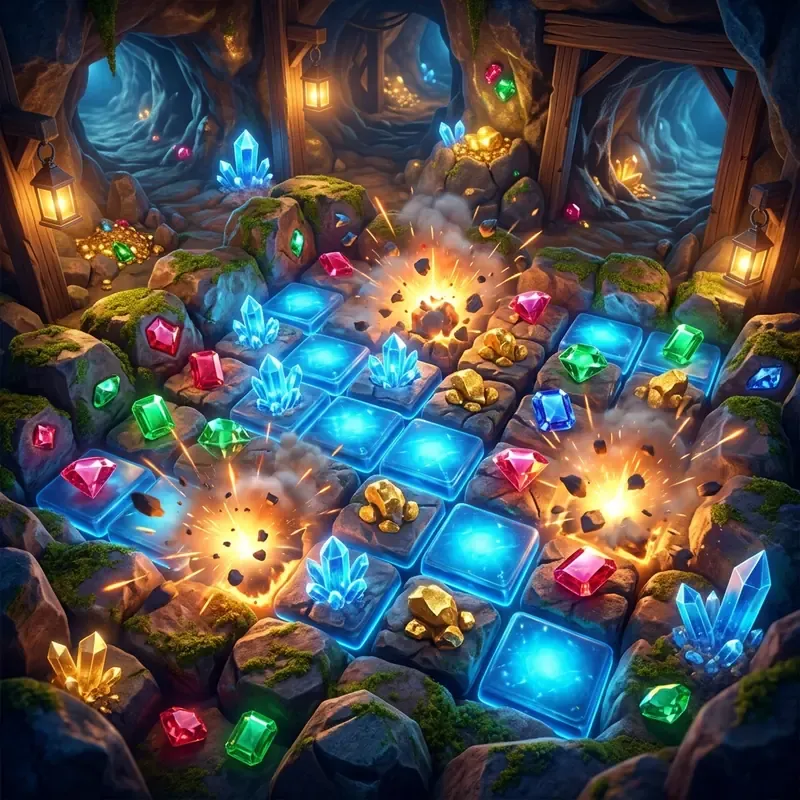
Mines is an instant-win casino game built on a hidden grid where players select safe tiles to build a multiplier while avoiding buried mines. The core loop rests on one trade-off: each revealed safe tile lifts the accumulated payout, but uncovering a single mine ends the round instantly and forfeits the stake.

Unlike traditional video slots with fixed paylines and automated reels, the mines casino game format hands players direct manual control over the grid setup and the timing of their exit. You set the number of mines hidden across the board before launching a round, and that single choice dictates both the probability of hitting a trap and the speed at which the multiplier escalates. Because immediate cash-out decisions sit alongside adjustable risk tiers, mines is usually filed under both instant games and crash-style titles in casino lobbies.

Every round runs on a covered layout where outcomes are governed by a certified Random Number Generator (RNG) or a cryptographic Provably Fair algorithm. The mathematics ensure that each click on hidden tiles is evaluated independently against the remaining unrevealed positions. So understanding how safe tiles and mine coordinates are distributed matters if you want a realistic read on session volatility and expected return.

The Playing Field, Hidden Mines and

The Playing Field, Hidden Mines and Safe Tiles

The standard Mines board is a 5×5 grid of 25 tiles, beneath which a chosen quantity of hidden mines and safe spots sit in random positions. At the start of a round all 25 tiles are face down, concealing their contents until you select a cell.

When a tile is selected, the game engine evaluates the underlying coordinate:

  • Safe tile: no mine is present, a gem or safe symbol appears, and the payout multiplier increases based on how many unrevealed safe options remain.
  • Hidden mine: the explosive symbol is revealed, the round terminates immediately, and the entire wager for that round is lost.

A round continues as long as you keep managing to reveal safe tiles or choose to trigger an early cash out. Because the distribution of hidden mines is fixed at the start of each round via server-side randomisation, the proportion of safe cells to dangerous cells shifts with every successful click. Both the payout value and the probability of hitting a mine on the next attempt rise together.

In Provably Fair implementations, the server seed, client seed and round nonce are committed before the first click. That commitment is what allows a player to verify, after the round closes, that mine coordinates were not shuffled mid-round in response to their selections. A small technical detail, but it is the difference between trusting a claim and checking it.

How the Number of Mines Affects

How the Number of Mines Affects Risk and the Multiplier

The number of mines chosen before a round starts is the primary risk dial. It sets the ratio of safe tiles to hazards on the board. Selecting more mines shrinks the pool of safe cells, which sharply increases risk per step while accelerating the growth curve of the potential multiplier.

Configure a 5×5 grid with 1 mine and you leave 24 safe tiles, a 96% chance (24/25) of a safe reveal on the first pick, paired with a modest starting multiplier. Select 10 or 15 mines and the safe cells drop to 15 or 10 respectively. Survival probability falls, while potential payouts on the very first safe click rise substantially.

Chosen Number of MinesSafe Tiles Remaining (5×5 Grid)Initial Safe Pick ProbabilityRisk ProfileMultiplier Acceleration Rate
1 mine24 safe tiles96.0%Ultra-lowVery slow (gradual incremental gains)
3 mines22 safe tiles88.0%LowModerate (balanced for extended sessions)
5 mines20 safe tiles80.0%MediumAccelerated (steep curve after 2–3 picks)
10 mines15 safe tiles60.0%HighFast (high payout potential per safe pick)
15+ mines10 or fewer safe tiles40.0% or lessVery high / extremeExponential (extreme volatility per pick)

Choosing the difficulty level is therefore a structural decision in mines game sessions, not a cosmetic one. Higher mine settings compress survival odds quickly, so you are weighing rapid multiplier growth against a much higher chance of an early loss.

Visual Mechanics Mines Round Flow. 1

Visual Mechanics: Mines Round Flow

  1. Parameter configuration: the player selects the base stake and sets the desired number of mines on the 5×5 grid (from 1 to 24).
  2. Round launch and seed generation: the RNG engine locks in hidden mine coordinates across the 25 tiles.
  3. Sequential tile selection: the player clicks a covered tile.
    • If safe: the tile reveals a safe symbol and the cash-out multiplier increases.
    • If mine: the round ends immediately and the stake is lost.
  4. Decision point after each reveal: continue picking, or cash out.
  5. Round settlement: cashing out instantly secures the accumulated payout and credits the balance. Hitting a mine forfeits the bet.

Note on visual mechanics: this flow illustrates the decision tree of a standard Mines round. The server locks in random positions before the first click, so player selections cannot alter pre-generated tile contents mid-round.

Mines Versions Compared: Spribe, Hacksaw Gaming, Stake Originals and Turbo Games

The core grid mechanics are broadly unified across the category, yet structural parameters vary a lot by developer. Reviewing provider specifications before you open a lobby helps you pick a title that matches your bankroll, rather than discovering a $0.20 minimum after depositing $10.

Provider / VariantGrid SizeRTP RangeMin / Max BetMax Payout MultiplierDistinct Feature
Spribe Mines5×5~97.0%$0.10 / $10010,000×Open-source Provably Fair verification widget
Hacksaw Gaming Mines5×5, 7×7, 9×996.0%–98.0%$0.20 / $1,00010,000×Variable grid sizes and custom hazard presets
Stake Originals Mines5×5up to 99.0%$0.01 / no fixed capDynamic per configurationLowest published house edge (1%), instant custom seeds
Turbo Games Mines5×5~95.0% (documented up to 99% on some settings)$0.10 / $3001,000×Integrated multiplayer activity feed
Nyx Mines (retail-facing casinos)5×5~96.0%*$0.20 / $1,00010,000×Diamond-and-mine skin used across regulated lobbies

* Published RTP for the same title may differ between jurisdictions and operators. Always open the in-game info panel or paytable to confirm the certified figure applied to your account. A headline number quoted on a review page, including this one, is not a substitute for the operator's own disclosure.

Where to Play Mines Online Demo

Where to Play Mines Online: Demo, Free and Real Money

Mines is available across online casino platforms in both free-play demo modes and real-money formats. Demo versions let you test mechanics with virtual credits and zero financial exposure. Real-money modes require registration, identity verification and an active deposit.

Choosing between mines online formats depends on what you actually want: practice and structural evaluation, or real-money wagering. Mines demo and mines free modes share an identical interface and mathematical layout, but they sit entirely outside financial cash flows and withdrawal systems. Platforms offering mines real money titles must meet regulatory requirements, including age verification (18+ in Australia) and player protection duties under frameworks such as the Interactive Gambling Act.

When deciding where to play mines, operator credentials, payout processing speeds and licence validity matter more than the size of a welcome offer. Reputable casino online environments publish clear terms of service, visible Return to Player (RTP) documentation and accessible safer gambling controls inside the account dashboard. If those three things are hard to find, that is your answer already.

Mines Demo and Free Mode for

Mines Demo and Free Mode for Learning the Game

A mines demo or mines free mode gives full operational access using a simulated balance, so you can explore mechanics without money at risk. Practice modes replicate the same grid layout, variable mine selection and multiplier progression found in the paid release.

Practical uses of free play:

  • Testing mine configurations:watching how changing the number of mines reshapes multiplier growth without draining a real balance.
  • Evaluating multiplier thresholds:rehearsing cash-out timing across conservative and aggressive pick sequences to feel grid volatility.
  • Getting comfortable with controls:avoiding accidental extra picks or misclicks before real funds are involved.

Demo modes remove financial risk, but they also remove the psychological pressure of real losses, which is a meaningful gap. And virtual winnings accumulated in free practice cannot be converted into currency or sent to a bank account.

"Young adults aged 18–24 commonly progress towards real-money wagering through loot-box style mechanics and social casino apps." Young Adults Gambling Online in the ACT (YAGO), ANU Centre for Gambling Research (2024). https://gambling.anu.edu.au/

That finding matters here, because the demo build is mechanically identical to the paid build. Treat free play as a controls-and-maths sandbox with a fixed end point, not as an open-ended warm-up that quietly graduates into a deposit.

Real Money Play, Bets and Access to Offers

Moving to mines real money play means placing wagers that deduct from an account balance and produce withdrawable payouts on a successful cash out. Access requires a licensed casino online, completed identity verification (KYC) and funding via approved payment methods.

Before activating a promotional offer or welcome bonus on instant games, read the underlying conditions:

Winport heading-banner
  • Wagering requirements:how many times the bonus amount must be turned over before withdrawals are permitted.
  • Game weighting limits:whether instant or crash-style titles like Mines contribute 100%, a reduced percentage, or 0% toward the target.
  • Maximum bet caps:whether bonus terms restrict the stake per round, for example a $5 ceiling per pick.

Comparative overview of Mines game formats: demo / free vs real money

ParameterMines Demo / Free ModeMines Real Money Mode
Financial riskZero (operates via virtual credits)Full exposure of the placed real-money stake
Account requirementsOften available without registration or depositRequires registration, age verification (18+) and deposit
Typical stake rangeFixed virtual credit balance, no cash value$0.01–$0.20 minimum up to $100–$1,000 maximum, provider dependent
Cash out and withdrawalsSimulated only; credits cannot be withdrawnReal payouts credited to balance; withdrawable subject to operator terms
Bonus eligibilityIneligible for real promotions or cash rewardsEligible for deposit matches and cashbacks, subject to game weighting
Primary purposeLearning mechanics, interface testing, risk-free practiceReal-money wagering and entertainment under regulated conditions

Summary of formats: demo modes work as educational tools for inspecting payout scales and practising board selection. Real-money play introduces genuine financial consequences, which makes verification, terms inspection and bankroll control non-optional.

Pre-Deposit Checklist What to Verify Before

Pre-Deposit Checklist: What to Verify Before Funding an Account

  1. Licence details are published in the site footer with a verifiable licence number, not just a logo image.
  2. Game info panel displays the certified RTP for the Mines build you are about to open.
  3. Deposit, loss and session limits are available in account settings before your first deposit, not after it.
  4. Self-exclusion pathway is documented, including national tools such as BetStop.
  5. Bonus terms state the game weighting for instant games, the maximum bonus bet and any minimum cash-out multiplier.
  6. Withdrawal conditions specify processing times, KYC document requirements and any minimum withdrawal threshold.
  7. Payment methods exclude borrowed funds. Credit-based deposits are a documented risk marker for escalating losses.

Legal and compliance notice (Australia and regulated jurisdictions): Access to real-money online casino games, including Mines, is restricted to legal adults aged 18 and over. In Australia, the Interactive Gambling Act 2001 (Cth) prohibits the provision and advertising of unlicensed real-money online casino services to residents. This review content is informational only. Real-money gambling carries substantial financial risk, and players should verify local legal restrictions and operator licensing credentials before depositing funds. If gambling stops being recreational, free and confidential support is available via Gambling Help Online (1800 858 858) or through national self-exclusion tools such as BetStop.

"In 2024, 21% of adults in New South Wales experienced gambling-related harm, with online casino products among the leading contributors." NSW Gambling Survey 2024, Central Queensland University for the NSW Responsible Gambling Fund. https://www.responsiblegambling.nsw.gov.au/

How to Play Mines: Bet, Revealing Tiles and Cash Out

Playing a round of Mines involves four steps: set the stake, choose mine density, reveal safe tiles one at a time, then decide whether to collect or risk the accumulated amount. Every tile you open presents a binary outcome that changes the financial maths of the round.

To start mines play, you use a control panel placed beside or below the 5×5 grid. The objective when playing mines is rarely clearing the whole board. It is securing a workable multiplier and executing a cash out before a hazard appears. Systematic decisions beat continuous impulsive clicking, every time.

How to Set Your Bet and

How to Set Your Bet and Choose the Number of Mines

Two inputs need configuring before launch:

  1. Set bet: enter the stake for the round using numerical fields or quick-adjust buttons, for instance $0.10, $1.00 or $10.00. This figure is your absolute maximum exposure for that turn. Minimum stakes start at $0.01 in crypto-native builds such as stake mines on Stake Originals, and $0.10–$0.20 in standard fiat releases. Maximum stakes commonly cap at $100 (Spribe), $300 (Turbo Games) or $1,000 (Hacksaw Gaming, Nyx).
  2. Choose number of mines: select how many mines sit hidden across the 25 tiles. Standard settings allow anywhere from 1 to 24.

Adjusting either input recalculates the payout matrix instantly. A higher bet paired with a high mine count produces steep multiplier jumps. A lower stake with 1 or 2 mines produces micro-increments across successive safe reveals. Neither is "better". They simply spend your bankroll at different speeds.

"Changing wager parameters must not shift the theoretical return to player by more than 0.20% within a single game configuration." Australian/New Zealand Gaming Machine National Standard, Revision 11.1 (2022). https://www.anzgmns.com.au/

That tolerance principle explains why switching from 3 mines to 10 mines does not hand you a better or worse deal in expectation. Certified paytables raise the multiplier ladder in proportion to the reduced survival probability, so the underlying return stays effectively unchanged and only the volatility is transformed.

When to Continue and When to

When to Continue and When to Take the Cash Out

After a safe reveal, the interface updates with two competing numbers: the current cash-out value and the potential payout of the next successful pick. You then face the same choice again: continue and select another tile, or take the cash out and lock in profit.

  • Decision to continue: driven by the pull of a higher multiplier. Every opened safe cell reduces the remaining safe options while the number of hidden hazards stays fixed, which raises the risk on the next pick.
  • Decision to take cash out: secures the accumulated multiplier applied to your stake. The round ends immediately, winnings move to the main balance, and all unrevealed mine positions are displayed.

The decision rule has two halves. Mathematically, continuing is only defensible when the expected value of one more pick is no worse than banking the current value, and because the house edge is baked into every step of the paytable, that comparison never turns positive over the long run. Psychologically, the stopping point arrives the moment loss aversion and near-miss regret start driving clicks instead of your pre-set plan.

Editorial note: setting a fixed exit threshold before the round begins is a discipline device rather than a proven edge. Our view is that pre-committed exit points reduce mid-round hesitation, and we flag it as an operational recommendation that would benefit from dedicated behavioural research on instant-win games. No peer-reviewed study specific to Mines cash-out timing is currently available. Treat it as a self-control measure, not a mathematical improvement.

RTP, Odds and Winning Probability in

RTP, Odds and Winning Probability in Mines

Information notice: RTP and probability information in this section is general in nature and based on publicly available regulatory standards. Specific RTP values depend on the provider and should be verified in official game documentation or with the relevant regulator.

The mathematical model of Mines rests on two things: its Return to Player (RTP) baseline, documented by providers between roughly 95% and 99% depending on build and configuration, and hypergeometric probability curves governing safe cell selection. Understanding how odds shift per pick lets you evaluate expected value without inventing statistics.

Theoretical rtp is the share of total wagered capital that a game engine is designed to return to the collective player pool across millions of rounds. In a regulated game casino setting, RTP stays consistent whether you choose 1 mine or 15, because payout multipliers are adjusted in proportion to the shifting probabilities.

Short sessions, though, deviate wildly from long-run expectation. That is variance doing its job. Calculating exact probability per step means comparing the chosen number of mines against the remaining unrevealed coordinates.

Why More Mines Increases Risk and Potential Payout

Selecting more mines raises the hazard on every tile selection, since a larger share of the grid holds instant-loss traps. To hold the theoretical return steady, developers assign substantially larger potential multipliers as compensation for reduced success probability.

The probability ($P$) of selecting a safe tile on the first pick:

$$P(\text{Safe Pick 1}) = \frac{N - M}{N}$$

Where $N$ is total tiles (25 on a standard grid) and $M$ is the chosen number of mines.

Winport heading-banner
  • With 1 mine:$P(\text{Pick 1}) = \frac{25 - 1}{25} = \frac{24}{25} = 96.0%$.
  • With 5 mines:$P(\text{Pick 1}) = \frac{25 - 5}{25} = \frac{20}{25} = 80.0%$.
  • With 10 mines:$P(\text{Pick 1}) = \frac{25 - 10}{25} = \frac{15}{25} = 60.0%$.

As you keep revealing tiles inside the same round, the conditional probability of another safe spot falls. With 5 mines selected and 3 safe tiles already revealed, 22 tiles remain: 5 mines and 17 safe. The probability for Pick 4 becomes $\frac{17}{22} \approx 77.2%$. Because survival odds decline conditionally at every step, the multiplier scales up quickly to balance it.

Cumulative survival probability across a planned sequence of $K$ safe picks is the product of those conditional steps:

$$P(\text{Success across } K \text{ picks}) = \prod_{i=0}^{K-1} \frac{N - M - i}{N - i}$$

How to Read RTP Without False Expectations

An advertised rtp figure such as 97% or 98% applies to aggregate volume, not to your Tuesday evening. A high RTP does not promise that you will recover 97% of a specific real money bankroll inside a 30-minute session.

"RTP is a long-run average calculated across millions of games; within a single session the realised figure can deviate substantially from the theoretical value." Western Australian Electronic Gaming Machines Policy, WA Department of Local Government, Sport and Cultural Industries. https://www.dlgsc.wa.gov.au/

Key distinctions for instant games:

Winport heading-banner
  • Theoretical long-term average:the 97% figure is calculated across millions of simulated turns under laboratory conditions, for example in test certificates issued by bodies such as iTech Labs or eCOGRA.
  • Regulatory floor for comparison:in Australia, the minimum RTP for electronic gaming machines in clubs and pubs ranges from 85% to 87.5% depending on the state, while casinos typically operate at a higher minimum. How electronic gambling machines work, Australian Institute of Family Studies. https://aifs.gov.au/ Measured against that benchmark, a certified 97–99% instant game is comparatively generous, though the house edge remains structurally against the player.
  • Short-term variance:individual sessions swing hard. A player can lose an entire session bankroll in 5 consecutive rounds, or gain 500% within 3 lucky picks.
  • House edge:an RTP of 97% means a 3% house edge ($100% - 97%$). On average the system retains three cents for every dollar wagered across total lifetime volume.

Editorial provenance: our comparison methodology for instant-win product pages is documented in our iGaming editorial standards resource, where the review team requires any published RTP figure to appear alongside a plain-language variance disclaimer. That is internal editorial policy, not an independent audit finding, and we present it as such. The verifiable claims about RTP behaviour in this section rest on the regulatory sources cited above.

Mines risk vs return matrix (5×5 grid, 25 total tiles)

Configured Mine CountRemaining Safe TilesPick 1 Odds of SuccessPick 3 Survival ProbabilityRisk CategoryMultiplier Acceleration
1 mine2496.0%88.0%Low riskLow (micro-gains per pick)
3 mines2288.0%68.9%Moderate riskBalanced
5 mines2080.0%51.2%Medium-high riskAccelerated
10 mines1560.0%18.6%High riskSteep / aggressive
15 mines1040.0%4.3%Extreme riskExponential

Data verification note: odds calculations reflect standard hypergeometric distribution across a 25-cell grid. Specific multiplier values vary slightly between vendors such as Spribe, Turbo Games and Stake Originals, based on certified payout schedules and base RTP configurations.

How to Use a Mines Probability

How to Use a Mines Probability Calculator

A Mines calculator lets you simulate outcomes before risking capital. Enter three variables, grid size (typically 5×5), number of hidden mines ($M$) and target number of safe picks ($K$), and the tool returns the metrics that actually matter:

  1. Cumulative odds of success, computed via sequential hypergeometric trials: $$P(\text{Success}) = \prod_{i=0}^{K-1} \frac{N - M - i}{N - i}$$
  2. Fair multiplier versus actual multiplier, which exposes the margin the operator retains on that specific pick sequence. If the fair multiplier is 2.04× and the game pays 2.00×, that gap is your cost of playing the pattern.
  3. Expected value (EV), showing whether a sequence is consistent with long-term bankroll stability: $$EV = (P \times \text{Payout}) - \text{Stake}$$

Worked example. With 3 mines and a target of 3 safe picks: $P = \frac{22}{25} \times \frac{21}{24} \times \frac{20}{23} \approx 0.670$, or 67.0%. If that sequence pays 1.47× on a $1.00 stake, then $EV = (0.670 \times 1.47) - 1.00 \approx -0.015$. A one-and-a-half-cent expected cost per round, which is exactly what a 98–99% RTP looks like in practice.

Limitation: calculators clarify statistical odds for planned pick sequences. They cannot predict random seed outcomes, cannot detect where mines sit and cannot bypass server-side RNG. Any tool marketed as doing so is a prediction scam.

Game TitleCategoryStandard RTPHouse EdgePlayer Decision Control
Stake Originals MinesInstant / crashup to 99.00%~1.00%Full (manual cash-out and risk adjustment)
Spribe MinesInstant game~97.00%~3.00%Full (manual tile selection)
Turbo Games MinesInstant game~95.00%~5.00%Full (manual tile selection)
Gates of OlympusVideo slot96.50%3.50%None (automated reels)
Sweet BonanzaVideo slot96.48%3.52%None (automated reels)
Fruit PartyVideo slot96.47%3.53%None (automated reels)
European RouletteTable game97.30% (single zero)2.70%Partial (bet placement only)
Club/pub EGMs (AU floor)Land-based EGM85.00%–87.50% minimum12.50%–15.00%None
Mines Strategy Managing Risk and Bankroll

Mines Strategy: Managing Risk and Bankroll

Information notice: this section is general in nature and does not replace advice from a qualified professional. No strategy removes the mathematical house edge. If you notice signs of problem gambling, contact Gambling Help Online on 1800 858 858.

No approach alters the house edge or guarantees profit in Mines. Structured bankroll management does, however, reduce session volatility and slow capital depletion. Systematic play comes down to disciplined stake sizing, predetermined targets and refusing to feed cognitive gambling fallacies.

A workable mines strategy controls exposure rather than trying to beat the algorithm. Because outcomes come from independent random trials, mathematical expectation ($E[X]$) stays negative across every long-term real-money betting system. Effective management therefore aims at session boundaries, emotional control and capital protection during negative variance streaks.

Low-Risk and High-Risk Mines Strategies. Most

Low-Risk and High-Risk Mines Strategies

Most players settle into a conservative or an aggressive framework, depending on risk tolerance and session goals.

  • Low-risk framework (conservative):
    • Setup: 1 to 3 mines on the 5×5 board.
    • Execution: 2 to 4 safe tiles per round, modest multipliers of roughly 1.10× to 1.30×, then an immediate cash out.
    • Objective: high hit frequency and longer sessions with smaller single-round drawdowns.
  • Medium-risk framework (balanced):
    • Setup: 5 to 7 mines.
    • Execution: target 3 picks for multipliers in the 2.00×–4.00× band.
    • Objective: accepts roughly a coin-flip survival rate per round for meaningful multiplier growth, and demands stricter stake sizing than the conservative build.
  • High-risk framework (aggressive):
    • Setup: 8 to 15 mines.
    • Execution: 1 or 2 safe reveals maximum, capitalising on the sharp early multiplier jump of 2.00× or more, then cashing out.
    • Objective: accepts frequent round losses in exchange for occasional large payouts.

All three strategies carry the same inherent house edge over time. Conservative play produces small, frequent losses when a mine finally lands. Aggressive play produces long losing streaks broken by sudden bigger wins. Choosing between them is a volatility preference, not edge creation.

Structured Progression: The Paroli System Applied to Mines

Paroli is a positive-progression staking pattern borrowed from roulette, and functionally the inverse of Martingale. Base stake stays flat after losses, doubles only after wins, and resets after three consecutive successes. Applied to Mines, it caps drawdown during cold runs and tries to harvest short winning clusters.

Below is a simulated 10-round sequence on a 5×5 grid with 3 mines, targeting roughly a 1.47× cash out per round:

RoundStakeTarget MultiplierResultRound Profit/LossRunning Balance ShiftAction for Next Round
1$1.001.47×Win+$0.47+$0.47Double stake to $2.00
2$2.001.47×Win+$0.94+$1.41Double stake to $4.00
3$4.001.47×Win+$1.88+$3.29Reset to base stake ($1.00)
4$1.001.47×Loss−$1.00+$2.29Keep base stake ($1.00)
5$1.001.47×Win+$0.47+$2.76Double stake to $2.00
6$2.001.47×Loss−$2.00+$0.76Reset to base stake ($1.00)
7$1.001.47×Loss−$1.00−$0.24Keep base stake ($1.00)
8$1.001.47×Win+$0.47+$0.23Double stake to $2.00
9$2.001.47×Win+$0.94+$1.17Double stake to $4.00
10$4.001.47×Loss−$4.00−$2.83Reset to base stake ($1.00)

Operational rule: if a loss lands at step 2 or step 3 of the progression, drop straight back to the initial $1.00 unit to preserve profit banked in earlier cycles.

Honest assessment: the table shows the system's weakness rather than its strength. Nine of ten rounds behaved exactly as expected, yet one loss at the third rung wiped the cycle and closed the sequence at −$2.83. Paroli restrains losses during cold runs and needs no large bankroll, but it depends on short winning clusters that Mines does not reliably produce. A discipline framework. Not a profit engine.

The 10 Bets Mine-Count Rotation. A

The "10 Bets" Mine-Count Rotation

A second structured approach cycles the mine count across four series of ten rounds each, recording results as you go, so the outcomes of one series set the stakes for the next. You will need a notepad or a spreadsheet.
  • Series 1:10 rounds on 13 mines, cashing out above 2.02× (1 pick)
  • Series 2:10 rounds on 8 mines, cashing out above 2.13× (2 picks)
  • Series 3:10 rounds on 6 mines, cashing out above 2.30× (3 picks)
  • Series 4:10 rounds on 4 mines, cashing out above 2.05× (4 picks)

How the recording works. Start Series 1 with a flat $1.00 unit for all ten rounds. After each round, write the stake for the matching round of the next series: add one unit after a win, subtract one unit after a loss, never dropping below the $1.00 minimum. A loss in round 1 records $1.00 in the 8-mine row; a 2.02× win in round 2 records $2.00. Once the row is complete, switch the grid to 8 mines, play those recorded stakes, and fill in the 6-mine row as you go. After Series 4, rotate back to 13 mines and begin again.

MinesPicks / TargetR1R2R3R4R5R6R7R8R9R10
131 pick / 2.02×$1 loss$1 win$1 win$1 loss$1 win$1 win$1 win$1 loss$1 win$1 loss
82 picks / 2.13×$1 win$2 loss$2 win$1 loss$2 win$2 loss$2 loss$1 loss$2 loss$1 loss
63 picks / 2.30×$2 win$1 win$3 win$1 win$3 win$1 loss$1 loss$1 loss$1 loss$1 loss
44 picks / 2.05×$3 win$2 win$4 win$2 win$4 loss$1 loss$1 loss$1 win$1 win$1 loss
13 (next cycle)1 pick / 2.02×$4$3$5$3$3$1$1$2$2$1

The rotation's practical value is the hard stop structure it imposes: ten rounds, then a settings change, then a written record. Stop after ten to twelve completed rows regardless of result. Like every staking system, it cannot overcome negative expected value. Over a long enough run the house edge reasserts itself, and the recorded ladder simply documents the decline in more detail.

Bankroll Limits and Why You Should Avoid Pattern Hunting

Strict bankroll controls remain the single most effective barrier against excessive losses when playing mines. Setting explicit financial limits before you launch the game keeps sessions inside affordable boundaries.

Core principles of session bankroll management:

  • The 1–2% staking rule: keep individual round bets to 1% or 2% of allocated session funds. On a $100 session bankroll, that is $1.00 to $2.00 per round.

"58% of gamblers at high risk of harm loaded more than $50 per session, while 47.9% of no-risk gamblers stayed at $20 or less." NGTS Research Snapshot, Pokies gambling sessions and risk of harm, AIFS Australian Gambling Research Centre (2023). https://aifs.gov.au/

  • Session stop-loss limits: set a non-negotiable point where play ends if funds drop by a fixed percentage, for example a 30% drawdown.

"Median session length was 2 hours among gamblers at high risk of harm, compared with 45 minutes among no-risk gamblers; 40 minutes marked the key threshold of difference." NGTS Research Snapshot, Pokies gambling sessions and risk of harm, AIFS Australian Gambling Research Centre (2023). https://aifs.gov.au/

Because Mines rounds resolve in seconds

Because Mines rounds resolve in seconds rather than minutes, a 40-minute clock can absorb hundreds of wagers. A time limit alongside a money limit is therefore more protective in instant games than in reel-based play.

  • Profit targets: define a realistic exit for positive sessions, such as cashing out and closing the game after a 20% gain on starting capital.
  • Separate funding only: never top up mid-session from savings, salary buffers or credit. The top-up is the exact moment a bounded session turns open-ended.

And avoid pattern hunting, the habit of clicking specific visual layouts such as corners, diagonals or "zigzag" paths in the belief that past mine placements influence future ones.

"Believing that a specific tile is 'due' to be safe because it revealed a mine in the previous three rounds is a textbook Gambler's Fallacy. Certified RNG algorithms generate fresh coordinates for every round. The board has no memory, and visual geometric patterns provide zero mathematical advantage." Claire Bennett, Senior Casino Content Editor (editorial brief)

The same logic dismantles the "hot hand" version of the error. Three winning rounds at 10 mines do not raise the probability of a fourth. Round four opens with the same 60% first-pick survival rate as round one did.

Mines Mobile and Download Running the

Mines Mobile and Download: Running the Game on Your Device

Mines is built with mobile-optimised HTML5, so it loads directly in a standard mobile browser without a dedicated software install. The responsive interface adapts grid dimensions and touch controls for smartphones and tablets automatically.

Players seeking mines mobile access do not need to hunt for App Store or Google Play download files. Modern casino games delivered through HTML5 open inside Safari, Chrome or Firefox on iOS and Android. That architecture keeps everything synchronised across platforms: identical RNG algorithms, RTP tables and security protocols on desktop and mobile alike.

Cross-platform compatibility: browser instant play vs native app vs third-party APK

Access MethodInstall RequiredRNG / RTP SourceSecurity Profile
HTML5 mobile browser (iOS / Android)None, loads instantlyOperator's certified server-side engineSSL-encrypted, safest default route
Official operator app (where licensed)Yes, via App Store or Google PlayIdentical server-side engineStore-vetted, supports biometric login
Third-party "Mines" APK or .exeYes, sideloaded from an unknown sourceUnverifiable, no certificationHigh malware and credential-theft risk, avoid

No native download is required to play Mines on a phone or tablet.

Key features of mobile instant play:

Winport heading-banner
  • Touchscreen navigation:large, tap-friendly tiles suited to single-thumb or two-handed input.
  • Biometric security:integration with Face ID or fingerprint login when accessing licensed platforms.
  • Data efficiency:lightweight graphical assets load fast and consume less mobile data than heavy 3D video slots.

Be cautious with third-party websites offering standalone mines download APK files or executables. Sideloading unverified files from outside official casino portals carries real malware and data-theft risk. Opening the game through a verified, SSL-encrypted mobile browser stays the safest route.

FAQ: Common Questions About Mines Casino

This section answers recurring questions on game integrity, software manipulation claims, bonus terms, limits and operator mechanics across mines casino platforms.

Do Mines Hacks or Guaranteed Strategies

Do Mines Hacks or Guaranteed Strategies Exist?

No. There are no functional hacks, software predictors or guaranteed winning systems for Mines. Third-party websites and social channels selling "Mines predictor bots" or "signals software" are running fraudulent schemes designed to harvest user data or subscription fees.

Regulated casino games rely on server-side Random Number Generators or cryptographic Provably Fair algorithms, with outcome calculation performed entirely on secure remote servers. Regulation reinforces this: NSW Independent Liquor and Gaming Authority EGM guidelines require certified RNGs subject to independent testing, and information-security baselines such as ISO/IEC 27001:2022 mandate the access control and logging that make silent tampering impractical. Client-side applications and external scripts cannot intercept or predict future tile coordinates, because the mathematical sequence is generated from secure seeds before any tile is selected. Installing unverified browser extensions or prediction software compromises your device and triggers account termination under casino terms of service.

The cost of buying into these claims is rarely limited to the subscription fee.

"In 2024, 5.8% of Australian adults, around 1.2 million people, were harmed by another person's gambling in the previous 12 months." Harm from someone else's gambling: affected others in the Australian population, 2024, Suomi, Hahn and Biddle, POLIS@ANU. https://polis.anu.edu.au/

Can Bonuses Be Used on Mines

Can Bonuses Be Used on Mines?

Often yes, though eligibility and contribution weightings vary sharply between operators. Many casinos file Mines, crash games and instant-win titles under "Specialty" or "Instant Games", categories that frequently carry their own promotional wagering rules.

Before opting into a bonus for Mines, check three parameters:

  1. Wagering contribution percentage: slots often contribute 100% toward rollover, whereas instant games like Mines may contribute 10% to 20%, or nothing at all.
  2. Maximum permitted stake: bonus terms usually enforce a maximum bet per round when promotional funds are in play, commonly $5.00.
  3. Cash-out multiplier minimums: some terms require bonus-funded picks to reach a minimum multiplier, such as 1.50×, for the stake to count toward rollover.

Worked wagering example. Take a $100 bonus with a 30× rollover requirement. On a slot weighted at 100%, you must turn over $100 × 30 = $3,000. If Mines contributes only 10%, every $1 wagered counts as $0.10, so the requirement becomes $3,000 ÷ 0.10 = $30,000 in Mines turnover. At a $5 bonus bet cap, that is 6,000 rounds. Against a 2% effective house edge, the expected cost of clearing it in Mines is roughly $600, which is six times the bonus itself. This is why the weighting line in the terms matters far more than the headline percentage.

Reading the terms before accepting an offer prevents nasty surprises around bonus forfeiture or withdrawal restrictions. The same attention deserves to extend to the protective tools sitting in the same account menu.

"Most of the 2,603 online gamblers surveyed viewed harm-reduction tools such as deposit limits and BetStop as reactive measures 'for problem gamblers' rather than for themselves." NGTS Research Snapshot, Consumer perspectives on online betting, AIFS Australian Gambling Research Centre (2025, fieldwork 2023). https://aifs.gov.au/

Quick Answers on Limits, Bets and Payouts

Frequently Asked Questions

Appendix A Editorial Revision Log. For

Appendix A: Editorial Revision Log

For transparency, the following passages from the previous published version were revised in this update. Both versions are retained so readers can audit the change.
  • Previous wording (superseded):"In an editorial compliance audit of iGaming review standards conducted for online brand comparison platforms (such as analysis published on winport-austria.com), content teams evaluated over 50 instant-win product pages to ensure RTP figures were presented alongside clear variance disclaimers. The audit revealed that failing to contextualise short-term dispersion led users to misinterpret theoretical RTP as a session balance guarantee, reinforcing the need for editorial transparency."
  • Reason for revision:the passage framed an internal editorial process as an audit finding without publishing a methodology or an independent source. The current text restates it explicitly as internal editorial policy and moves the load-bearing claims about RTP behaviour onto cited regulatory sources (WA Department of Local Government, Sport and Cultural Industries; Australian Institute of Family Studies).
  • Previous wording (superseded):"Establishing fixed exit thresholds prior to starting a round eliminates emotional hesitation during active gameplay, preventing players from over-extending safe sequences into eventual mine triggers."
  • Reason for revision:the claim that pre-set thresholds "eliminate" hesitation is stronger than the available evidence supports. The current text presents pre-commitment as a self-control measure and flags the absence of behavioural research specific to instant-win cash-out timing.
  • Previous wording (superseded):"Expert advice on the Gambler's Fallacy: 'Believing that a specific tile is "due" to be safe because it revealed a mine in the previous three rounds is a classic manifestation of the Gambler's Fallacy...'", presented without attribution.
  • Reason for revision:the quotation is now attributed to Claire Bennett, Senior Casino Content Editor, in line with the editorial brief.

Responsible gambling: gambling is entertainment, not income. Set deposit, loss and time limits before you play, never chase losses and never gamble with borrowed money. Free, confidential support is available 24/7 in Australia through Gambling Help Online on 1800 858 858 or via the national self-exclusion register BetStop. This article is informational and does not constitute financial, legal or medical advice. 18+.