
Winport
Balloon Game Demo Play, Strategy, Risk

Balloon Game: Demo Play, Strategy, Risk Control and the Australian Context

Last updated: February 2026 · Reviewed by the iGaming editorial team

In short: "Balloon Game" is used for two very different things: a psychometric risk-assessment exercise (the Pymetrics Balloon Game and the academic Balloon Analogue Risk Task, or BART) and a family of balloon-themed online crash-style gambling products with demo and real-money modes. The mechanic is identical in both cases: inflate, watch the value grow, cash out before the pop. This guide covers exact test parameters (39 rounds, US$0.05 per pump, 3 balloon colours), average benchmarks (24–25 balloons banked, about US$18, roughly 4 minutes), two role-matched strategies with target numbers, the maths of the break-even point (10 pumps under a uniform prior), balloon demo practice, mobile access, and the Australian regulatory and harm-minimisation context.
Table of ContentCloseOpen
Why This Guide Matters Before You

Why This Guide Matters Before You Play or Sit the Test

Most articles about balloon play pick one meaning and ignore the other. That is where the trouble starts. A candidate reads gambling tips before an assessment and behaves erratically. A player reads assessment advice and assumes a stopping rule will beat a commercial game. Neither ends well.

So we have separated the two contexts deliberately. Where numbers exist, they are quoted with a source. Where they do not exist, we say so instead of inventing an RTP figure. And because balloon real money play is regulated in Australia, the legal and harm-minimisation material sits inside the guide rather than in a footnote nobody reads.

One more framing note. Everything below reduces to a single question: when do you stop? Hold that thought.

Defining Balloon Game in Relation to

Defining Balloon Game in Relation to Balloon-Type Risk Tasks and Simulated Gambling

The term "Balloon Game" travels across three overlapping worlds, and confusing them is the single most common reason candidates and players arrive at the wrong strategy.

1. The recruitment version. The Pymetrics Balloon Game is the most recognisable exercise in the twelve-game Pymetrics battery (acquired by Harver in 2022 and folded into its assessment platform). Major employers, including Amazon, BCG, Bain and other consulting, banking and technology recruiters, use it to build a behavioural profile of candidates. Nothing is wagered and nothing is won: the dollars on screen are scoring units, not money.

2. The academic version. The Balloon Analogue Risk Task (BART) is a validated laboratory instrument used in psychology and behavioural economics to measure risk propensity. The Pymetrics exercise is a gamified descendant of it.

3. The commercial version. Balloon-themed instant/crash products sold by casino game studios, where a balloon inflates, a multiplier climbs, and the player must cash out before it bursts. Where such a product is offered for money to Australian residents, it sits inside gambling law rather than assessment practice, and the operator must hold an appropriate licence. That is why anyone comparing platforms should start with lawfully operating online casinos in Australia rather than unlicensed offshore sites.

A balloon product marketed with balloon demo and balloon free options is best described as a simulated-gambling format: play that reproduces the structure, sound and feedback of wagering without money changing hands. It is worth stating plainly that this categorisation is an editorial reading of how demo play functions, not a definition drawn from a regulator's product taxonomy. No primary vendor or regulator document in our source set formally classifies balloon demo modes, and that gap is flagged again below.

The Balloon Analogue Risk Task (BART) as a Measure of Risk Propensity

The BART presents a participant with a series of balloons. Each pump adds a small amount to a temporary bank; the participant can cash out at any time or keep pumping. Each balloon has a hidden, randomly determined bursting point. The task therefore produces several behavioural outputs at once: average pumps per unstopped balloon, number of explosions, adjustment after an explosion, and the trajectory of pumping across trials. All of them can be analysed to infer risk propensity.

«The BART typically uses 30 balloons, each pump is worth five cents, and the average explosion point is around 64 pumps.» Source: ScienceDirect Topics, BART overview.

Those numbers matter because they explain the shape of the task. With a mean burst point near 64 and a possible range far wider, no fixed "safe number" exists. What the instrument records is not accuracy but disposition: how much uncertainty a person will hold in exchange for incremental gain, and how quickly they update after a loss.

Independent hobbyist analysis of the same task has reached similar conclusions from a purely mathematical angle. Data scientist Gijs Koot, who played the task as part of a work assessment, framed it as an explicit exploration and exploitation trade-off:

«In the game, it is probably worth sacrificing a couple of balloons to learn about how many pumps they can take.» Source: Gijs Koot, "Popping balloons risk assessment game" (2021).

Sacrificing balloons on purpose feels wrong. It usually is not.

Balloon Game, Risk and the Player's

Balloon Game, Risk and the Player's Choice

Every round hands you the same choice under fog. You know the increment, you do not know the ceiling, and each additional pump both raises the reward and shortens the runway. In assessment settings that choice reveals your tolerance for ambiguity. In a balloon casino product it decides how much of the round's provisional balance you actually keep.

The behavioural difference between the two is money, and money changes the experience. Losing a scoring unit is annoying. Losing a stake after a burst at a high multiplier is the moment when chasing behaviour starts, which is exactly why the responsible gambling section below is not decoration.

Online Format, Balloons as a Risk

The balloon online format adapts readily to browser delivery: visual animation, real-time balance updates and a single-tap control make inflation and bursting easy to render on a laptop or a handset. This is an observation about the format's simplicity rather than a proven claim of superior engagement. We found no peer-reviewed study measuring engagement specifically for balloon-themed online products, so treat "highly engaging" language in marketing material with caution.

The balloon is an unusually effective metaphor for risk because it makes three abstractions physical:

  • Accumulation is visible. The balloon grows; so does the number.
  • Loss is total and instantaneous. A burst wipes the round, not part of it.
  • The threshold is hidden. You never see how much capacity remains.

In assessment settings, the dollars are symbolic. In gambling settings, they are not, and the same mechanic that makes a psychometric task diagnostic makes a commercial product financially risky. Recognising which context you are in is the first strategic decision you make.

How Balloon Differs From Other Online Games

Compared with a slot, a balloon game gives you one live lever instead of a fixed spin outcome. Compared with table games, there is no dealer, no card sequence and no side-bet grid; there is a rising number and a stop button. Compared with a plane or rocket crash title, the visual is friendlier, which is worth noticing rather than trusting. Cartoon balloons do not soften the volatility.

The practical consequence: the balloon game experience feels skill-based because you control the timing. Timing is real. The distribution behind the burst is not something you control.

Balloon Game Mechanics Step by Step

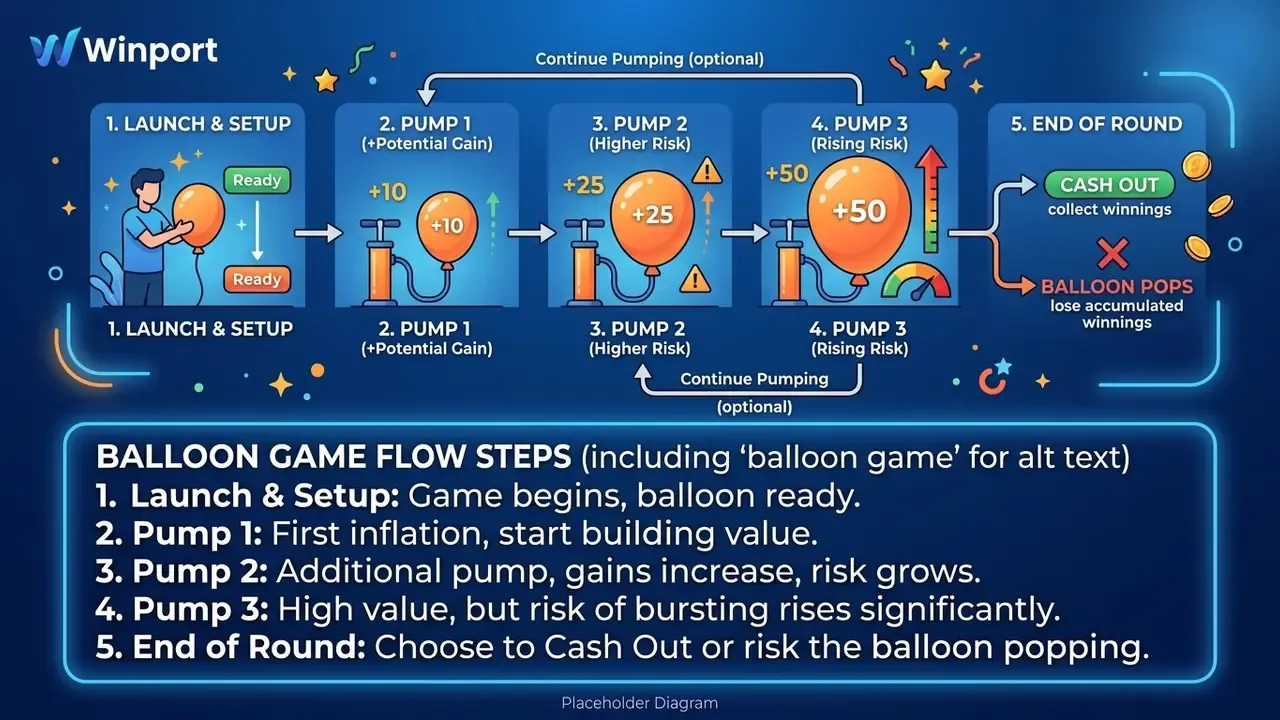
The loop below applies to the recruitment version, the BART and balloon-style crash games alike:
1
A new balloon appears, deflated, with an unknown maximum capacity.
2
You press "pump" (or "inflate"). Each press adds a fixed increment to the round's provisional balance and increases the probability that the next press bursts the balloon.
3
Risk accumulates. Every successful pump narrows the remaining safe range, so the marginal pump is always riskier than the one before it.
4
You choose: bank or continue. Banking locks the provisional amount into your permanent balance and ends the round.
5
If the balloon bursts, the provisional amount for that round is lost in full; the permanent balance is untouched, and a new balloon begins.
6
Repeat until all rounds are used.
Key insight: the only decision that exists is when to stop. Everything else, colour, animation, sound, is information or decoration around that single choice.

Pymetrics Balloon Game: Exact Parameters and What It Measures

Parameters of the Pymetrics Balloon Game:

ParameterValue
Number of rounds39 balloons
Colour categories3 colours, each with its own hidden burst pattern and probability
Reward per pump+US$0.05
ObjectiveBank the round total before the balloon pops; a pop zeroes that round only
Time limitNone (average completion time about 4 minutes)
Traits assessedRisk-taking and Learning / pattern recognition

Risk-taking

This trait is straightforward: how much exposure will you accept before banking? A candidate who saves nearly every balloon but banks very little reads as cautious. A candidate who pops many balloons yet finishes with a larger total reads as adventurous. Neither is "wrong". The profile is compared against the target profile for the role.

Learning. This is the part most

Learning

This is the part most candidates miss. Explosion patterns are not fully random. Each of the three colours carries a different burst probability. For illustration only, one colour might burst roughly once in ten pumps while another survives far longer. If you track outcomes by colour and adjust deliberately, your behaviour shows measurable learning across the 39 rounds. If you pump identically regardless of colour, you show none.

Updated: a common myth holds that balloon colours are cosmetic and bursts are purely random. That is incorrect for the Pymetrics version, where colour is the primary information channel in the game. A second myth holds that a strict timer applies; there is no time limit, although most candidates finish in about four minutes.

Benchmarks What an Average Result Looks

Benchmarks: What an Average Result Looks Like

Aggregated candidate benchmarks (based on a published review of 500+ test-takers by JobTestPrep):
  • Average balloons banked:24–25 of 39
  • Average amount banked:about US$18.00
  • Average completion time:about 4 minutes (no timer applied)

Pymetrics/Harver does not publish a "pass mark", and for good reason: the score is a fit judgement, not a ranking. Twenty-three balloons and US$22 may be an excellent outcome for a trading desk and a poor one for a compliance team.

Balloon Demo and Free Play Without

Balloon Demo and Free Play Without Risk

Balloon demo mode credits a virtual balance and lets you run the mechanic without wagering. Its practical value before real-money play is genuine but narrow:

  • Timing practice. You learn how quickly the multiplier accelerates and how responsive the cash-out control feels.
  • Strategy testing. You can run a cautious rule and an aggressive rule across many rounds and compare outcomes without financial exposure.
  • Emotional rehearsal. You observe your own reaction to a burst at a high multiplier, the moment when chasing behaviour typically begins.

How to start balloon free play, step by step:

  1. Open the game page on a licensed operator's site or the studio's own showcase.
  2. Select "Demo", "Fun" or "Practice" mode rather than the real-money tab.
  3. Confirm the virtual balance is displayed, not your cash balance.
  4. Write down one stopping rule before your first pump.
  5. Play at least 50 rounds and log every result, including bursts.
  6. Compare the logged average with your written rule, then decide whether the rule survives contact with data.

Information in this section is general in nature and is not a substitute for advice from a responsible gambling or mental health professional.

What Balloon Free Gives You Before

What Balloon Free Gives You Before Real Money

Three honest limitations deserve equal weight. First, demo results are not predictive of money outcomes; the absence of loss changes behaviour. Second, free modes can normalise the mechanic, which is the core concern in the simulated-gambling literature discussed below. Third, some free versions run at settings that are not identical to the real-money product, a discrepancy we could not resolve from vendor documentation.

What balloon free does give you is cheap familiarity: the interface, the pace, the sound of a burst, and an honest look at your own patience. If you notice yourself wanting to "test the strategy properly with real money", treat that impulse as data about you, not about the strategy.

Licensed operators are expected to provide deposit limits, session reminders, activity statements, cooling-off and self-exclusion. If you are in Australia and gambling is causing harm, free confidential support is available 24/7 through the National Gambling Helpline on 1800 858 858.

Balloon Strategy 1 Max Money for

Balloon Strategy 1: "Max Money" (for risk-oriented roles such as sales, trading, trade finance)

Use this when the role advertisement, competency framework or company values emphasise initiative, deal-making, ambiguity tolerance or commercial drive.
  • First 3–5 balloons:pump to the burst deliberately, to map the upper strength threshold of each of the three colours.
  • Main phase:pump each balloon roughly 10–15% beyond the average you have observed for that colour, and record the high end of the pump range that triggers bursts.
  • Late phase:hold the aggressive line; do not drift back to safety, or the profile becomes muddled.
  • Target metrics:balloons banked 18–19 of 39; total banked US$20–US$23.
Balloon Strategy 2 Max Balloons for

Balloon Strategy 2: "Max Balloons" (for conservative roles such as risk, finance, compliance, QA)

Use this when the role emphasises control, accuracy, governance, audit or process discipline.
  • First 3–5 balloons:bank after 3–5 pumps to establish a safe baseline threshold per colour.
  • Main phase:increase pump counts slowly and steadily, stopping at the first sign that you are approaching a colour's observed burst zone.
  • Late phase:keep variance low; consistency is itself a signal.
  • Target metrics:balloons banked 30–31 of 39; total banked US$17–US$18 (around the average).

How to choose: read the job ad, the position description and the employer's stated values. Words like "entrepreneurial", "fast-moving" and "ownership" point to Max Money; "controls", "governance", "accuracy" and "assurance" point to Max Balloons. If the role blends both, aim close to the benchmark (24–25 balloons, about US$18) while demonstrating visible colour-based learning.

Cautious vs Risky Balloon Strategy: Comparison Table

ParameterCautious strategyRisky strategy
Target multiplier / pump countLow, early exitHigh, long hold
Potential riskLow; losses are small and rareHigh; frequent total round losses
Bank dynamicsSmooth, incremental growthSharp swings, deep drawdowns
Playing styleBank early, protect the baselineWait for the top of the range
Assessment readControlled, process-drivenAdventurous, opportunity-driven
Best suited toCompliance, risk, finance, QASales, trading, growth, BD

Read the table this way. The cautious column trades upside for survival: more balloons kept, smaller totals, fewer emotional shocks. The risky column trades survival for upside: fewer balloons kept, wider outcomes, and a real chance of a flat round after several bursts. In gambling contexts the same table describes exposure, not employability, and neither column changes the underlying house edge.

The Mathematics of Decision-Making Expected Value

The Mathematics of Decision-Making: Expected Value and the Break-Even Point

Assume the maximum number of pumps a balloon can take, M, is uniformly distributed on the interval [1, N]. After i successful pumps you have eliminated every value of M below i, so your posterior belief is uniform over what remains: a simple Bayesian update on a uniform prior.

The expected value of one more pump is then:

E(pump) = ((N − i − 1) / (N − i)) × (i + 1)

This is weighed against the certain payoff of banking now, which is simply i.

Worked example (N = 20). At 19 pumps, the surviving possibilities are equally likely, so the probability of surviving one more pump is ½ and E(pump) = ½ × 20 = 10, clearly worse than banking 19. At 19 with a one-in-three burst probability, E(pump) = ⅔ × 19 ≈ 12.67, still worse. Working backwards, the two curves cross at 10 pumps: that is the break-even point under a uniform prior on [1, 20], where risking one more pump and cashing out have equal expected payoff. Below 10, pumping is rational; above 10, banking is.

# Expected value of one more pump under a uniform prior on [1, max_limit]
def expected_value(current_pumps, max_limit=20):
    prob_success = (max_limit - current_pumps - 1) / (max_limit - current_pumps)
    return prob_success * (current_pumps + 1)

# Find the crossover point where pumping stops beating an immediate cash-out
for i in range(1, 15):
    ev = expected_value(i)
    verdict = "PUMP" if ev > i else "CASH"
    print(f"Pump {i}: EV = {ev:.2f} vs Cash = {i}  ->  {verdict}")

The same analysis in Julia, following Koot's original approach:

using Plots, Distributions

belief = Uniform(1, 21)                      # uniform prior on the burst point
ev_pump(i) = (i + 1) * (20 - i) / (21 - i)   # expected value of one more pump

scatter(ev_pump, 0:20, labels = "Pump")
scatter!(i -> i, 0:20, labels = "Cash")      # curves cross at i = 10

Three caveats before you use this at a real assessment or a real cashier:

  1. The uniform prior is an assumption of convenience. Change the distribution (Poisson, truncated normal, colour-conditioned) and the break-even point moves.
  2. The single-balloon model ignores the exploration budget. With 39 balloons you can afford to spend several learning colour thresholds; with one, you cannot.
  3. In a commercial gambling product the return-to-player percentage and volatility are set by the operator's mathematics, not by your prior. No stopping rule converts a negative expected value into a positive one.

That third point is the one people skip, so it bears repeating in plain words: a good rule limits how fast you lose, not whether the edge belongs to the house.

Comparison with Aviator, JetX and Other

Comparison with Aviator, JetX and Other Instant/Crash Games

Structurally, balloon-style products belong to the instant/crash family: a value climbs, the player must cash out before a randomly timed termination event, and any un-cashed stake is lost. The visual metaphor differs, a plane, a rocket, a balloon, while the decision architecture is the same single stopping choice.

Where the differences are claimed to lie (auto-cash-out thresholds, dual-bet slots, live multipliers, provably-fair seeds), we could not verify specifications for individual titles from primary vendor documentation within our source set. Likewise, no confirmed RTP figure, volatility rating or bet-range table for a specific SmartSoft Gaming "Balloon" release was available to us. Do not treat any RTP number quoted in an affiliate article as authoritative. Check the in-game information panel or the studio's own paytable before staking money.

Balloon Casino How Real-Money Access, KYC

Balloon Casino: How Real-Money Access, KYC and Withdrawals Work

Where a balloon-style product is offered for money, the pathway at regulated operators is fairly standard:
  • Registration:email or mobile number, password, and account confirmation before real-money access.
  • Age verification:strictly 18+; operators must verify age before wagering.
  • Deposits:cards, e-wallets, bank transfer or local payment methods, with crediting times varying by method and jurisdiction. Note the Australian credit-card restriction described below.
  • Withdrawals:typically released only after KYC/AML checks, meaning government-issued ID plus proof of the payment instrument. Payments may be declined where details do not match the account holder.
  • Limits:deposit and withdrawal ceilings set by the operator and, where applicable, by the regulator.

The honest difference between balloon demo and balloon real money is not the interface. It is that a burst now costs you something, and that your withdrawal depends on documents, not on your last multiplier. Check the cashier page and the bonus terms before your first deposit, especially wagering, maximum bet while a bonus is active, expiry and whether instant-win titles even contribute.

Risk disclaimer: balloon casino play for real money involves financial risk. It is restricted to persons aged 18 and over in Australia. This section is general information only, not financial, legal or tax advice, and you should never stake funds you cannot afford to lose.

Balloon Download and Mobile Play. Do

Balloon Download and Mobile Play

Do you need a balloon download? Usually not. Instant and crash-style titles are built in HTML5, so balloon mobile play normally runs in a browser on Android or iOS with no installation at all. That matters for two reasons: browser play keeps you inside the licensed operator's environment, and it avoids the security risk attached to third-party files.

We could not verify from vendor documentation that an official standalone Balloon app or APK exists. Treat any site offering a "Balloon Game APK" as unverified, and remember that sideloaded gambling files are a common vector for credential theft.

Balloon Mobile: Browser Play and Device Experience

On a handset the controls shrink to one button, which helps and hurts. It helps because the balloon play loop is genuinely simple. It hurts because a mistap costs a round, and because mobile sessions tend to stretch out during idle moments.

Three practical notes for balloon online play on a phone:

  • Test the cash-out response in demo first; latency feels different on mobile data.
  • Turn on the operator's session reminder, then trust it rather than your own sense of time.
  • Rotate to landscape if the multiplier and the button overlap; small screens cause more errors than bad strategy does.

Australian Regulatory and Policy Context for Balloon Game and Similar Products

Information in this section is general in nature and does not replace legal or professional advice on licensing and compliance with gambling legislation.

Online Gambling Regulation under the Interactive Gambling Act and ACMA Enforcement

The Interactive Gambling Act 2001 (Cth) prohibits the supply of certain interactive gambling services to customers in Australia, and the Australian Communications and Media Authority (ACMA) enforces it: issuing formal warnings, referring matters for civil penalty, and asking internet service providers to block access to prohibited sites, many of which offered casino-style games. Between October and December 2023, ACMA reported action leading to the blocking of 58 sites connected with illegal gambling and affiliated services.

«58 sites linked to illegal online gambling and affiliate services were blocked between October and December 2023.» Source: ACMA, Action on interactive gambling: October to December 2023.

Any balloon-style product offered for real money to Australian residents therefore carries genuine legal exposure if it is not properly licensed. Compliant iGaming platforms publish their licensing details, corporate entity and complaints pathway; the absence of these is itself a red flag.

National Consumer Protection Framework and Gambling Reforms 2024–2026

The National Consumer Protection Framework for online wagering brings together measures such as a national self-exclusion register (BetStop), mandatory activity statements, consistent gambling messaging, staff training and restrictions on inducements. In June 2024 the Australian Government legislated to ban the use of credit cards, digital wallets and cryptocurrency for online wagering, which may reduce the ease of impulsive or credit-funded wagering.

«Credit cards, digital currency and credit-related products were banned for online wagering in June 2024.» Source: Australian Government response to the House of Representatives inquiry into online gambling.

Youth Gambling Behaviour and Simulated Gambling Prevalence

Australian research on young people has repeatedly found that simulated gambling has become more common than monetary gambling among youth.

«40.1% of young people reported simulated gambling in the past year, compared with 29.8% who reported monetary gambling.» Source: NSW Youth Gambling Study 2020, CQUniversity / NSW Responsible Gambling Fund.

This is directly relevant to balloon-style demo modes: a free-play balloon product is, functionally, simulated gambling, and its audience skews younger than the paying audience.

Adolescents' Engagement with Simulated Gambling and Gaming Disorder Risk

Studies of adolescents who engage with simulated gambling (social casino games, gambling-themed apps, demo modes and loot-box mechanics) have examined which activities independently predict gaming disorder. After adjusting for other forms of engagement, only social casino games remained a significant independent predictor.

«Past-month social casino gaming was associated with 2.5 times higher odds of gaming disorder (OR 2.5; 95% CI 1.54–4.02).» Source: Hing et al. (2023), Addictive Behaviors.

Simulated Gambling Harms and Classification Policy Responses

Australian classification policy has moved towards mandatory minimum classifications for games containing simulated gambling and paid loot boxes. The concern is specific: these mechanisms can give young people a gambling currency and a way to gamble while underage.

«Adolescents who purchase loot boxes are approximately six times more likely to experience problem gambling than those who do not.» Source: CQUniversity submission on classification guidelines (2023).

Evidence Gaps and Implications

Absence of Direct Balloon Game Casino

Absence of Direct Balloon Game Casino Research (2023–2026)

Within the sources available for this review, no peer-reviewed study or government report was identified that directly examines a commercial "Balloon Game" casino product with a demo mode, published strategy guides and real-money play. Read that as a limitation of our search rather than proof that no such research exists anywhere. We drew on regulator publications, Australian youth-gambling studies, BART literature and publicly available assessment guides, and did not include paywalled industry databases or vendor certification reports.

What this means in practice:

  • Claims that a specific stopping rule "beats" a balloon crash game are unsupported by evidence. The link sometimes drawn between adventurous balloon strategies and loss-chasing is plausible on the basis of general gambling research, but no study in our set traces that causal path for balloon products specifically.
  • Technical specifications, including RTP, volatility, bet limits, algorithm, APK availability and mobile-web parity, could not be verified from primary vendor documentation. Where you see them stated confidently, ask for the source.
  • The strongest evidence base concerns harm among young people and regulatory obligations on operators, not player-side advantage.
Pre-Play and Pre-Test Checklist. If you

Pre-Play and Pre-Test Checklist

If you are sitting the assessment:

  • Confirm the target profile from the job ad before your first pump.
  • Remember the parameters: 39 rounds, US$0.05 per pump, 3 colours, no timer.
  • Spend the first 3–5 balloons gathering colour information, deliberately rather than accidentally.
  • Track outcomes by colour; visible adaptation is what scores as "learning".
  • Aim at your chosen target band (18–19 balloons / US$20–23, or 30–31 balloons / US$17–18), not at "the highest score".
  • Finish all 39 rounds; an incomplete game cannot be profiled.

If you are playing for money:

  • Verify the operator's licence and entity details.
  • Check the in-game RTP and volatility panel yourself.
  • Read the bonus terms: wagering, max bet, expiry, game weighting.
  • Set a deposit limit and a session limit before your first stake.
  • Decide your cash-out multiplier in advance and log every round.
  • Never fund play with borrowed money.
  • Know where to get help: National Gambling Helpline 1800 858 858.

Balloon Game FAQ

Appendix A Sourcing Notes and Superseded

Appendix A: Sourcing Notes and Superseded Claims

For transparency, the following statements were revised during editing and are recorded here in their weaker original form:

  1. "Balloon Game marketed with demo and free-play options would also align with the category of demo games." Retained in the main text as an editorial categorisation, now explicitly flagged as unsupported by a regulator taxonomy.
  2. "The Balloon Game format is especially suited to online implementation." Reframed as an observation about interface simplicity, since no engagement study for balloon products was located.
  3. "Adventurous Balloon Game strategies could contribute to loss-chasing patterns." Retained as a plausible inference from general gambling research, with the absence of balloon-specific evidence stated.
  4. "No peer-reviewed or government research was found that directly studies a commercial Balloon Game casino product." Retained with an explicit statement of search limitations.
  5. "Balloon colours are cosmetic and bursts are random" and "a strict timer applies", both contradicted by the Pymetrics parameters and corrected in the main text.

General disclaimer: This article is educational and general in nature. It is not legal, financial, medical or employment advice. Gambling involves the risk of financial loss and is restricted to persons aged 18 and over in Australia. If gambling is affecting you or someone you know, contact the National Gambling Helpline on 1800 858 858.